
What are the top finance automation tools in 2026?
Comparison roundup of finance automation tools for 2026; Loopfour positioned on determinism, governance, and managed upkeep.

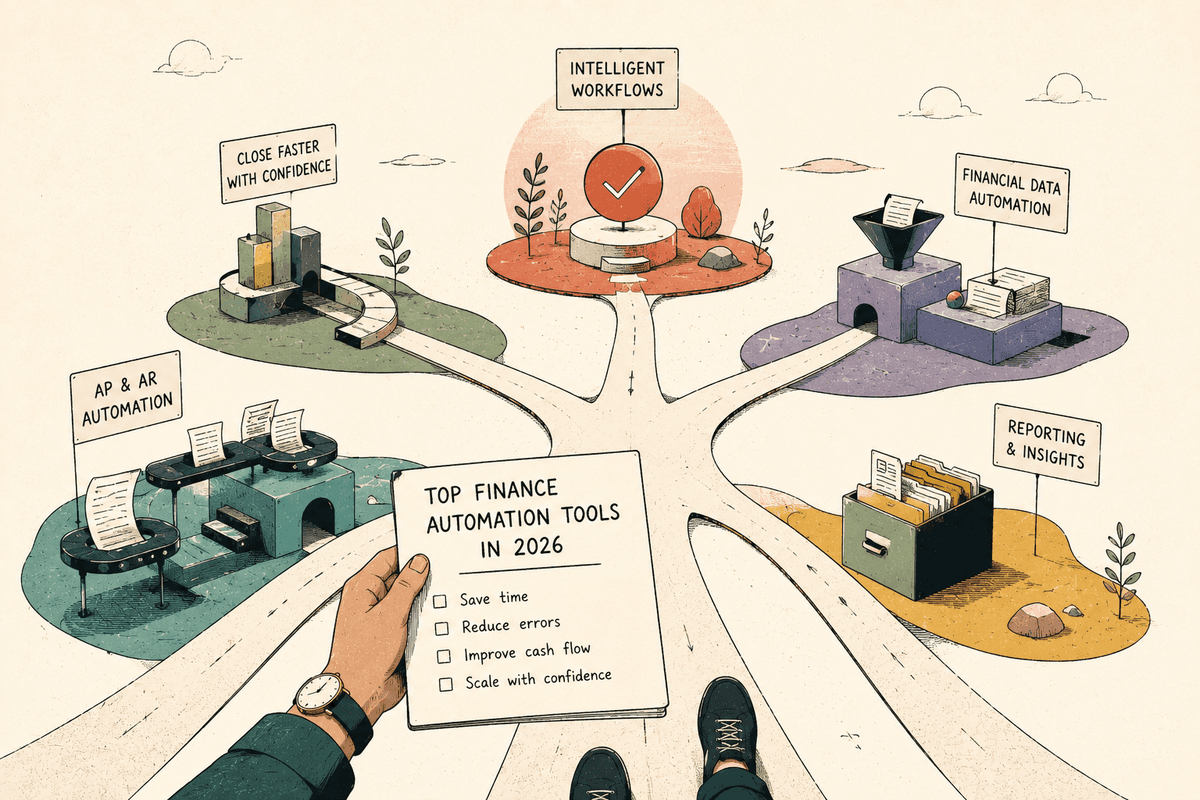
The top finance automation tools in 2026 cluster by function, not by brand. You will find strong point tools for accounts payable and receivable, month-end close and reconciliation, billing and revenue, and spend and expense, plus a newer category that orchestrates whole finance workflows across the stack. The right tools depend on the workflows you run most and the systems you already own. Two factors decide fit more than any feature list: whether the automation is deterministic (it runs the same way every time) and whether it leaves a complete audit trail. Read the roundup below by category, then match it to the work your team actually does.
Key takeaways
- Finance automation tools group into five categories: AP/AR automation, close and reconciliation, billing and revenue, spend and expense, and finance workflow orchestration.
- Point tools win on depth; orchestration tools win on end-to-end coverage across your existing systems.
- Determinism and auditability matter more than raw feature count in finance, where every run may be examined later.
- Your ERP stays the system of record. Automation tools sit around it, not in place of it.
- Loopfour is the deterministic orchestration layer that connects AP/AR, close, billing, and spend tools into one auditable flow where you approve only the exceptions.
- Choose by workflow, not by logo, start with the process your team dreads most.
The main categories of finance automation tools
Finance automation tools fall into five functional categories, and most teams end up running more than one. Understanding the categories first makes any shortlist easier to build, because you are matching tools to processes rather than comparing feature grids in isolation.
- AP/AR automation handles invoice capture, coding, approvals, payments, and collections. These tools remove manual data entry from the two highest-volume finance processes.
- Close and reconciliation platforms manage the month-end close: matching transactions, tracking tasks, reconciling accounts, and documenting the trail for review.
- Billing and revenue automation covers recurring billing, usage-based pricing, revenue recognition, and the movement from contract to cash.
- Spend and expense management covers corporate cards, employee reimbursements, and policy enforcement at the point of purchase.
- Finance workflow orchestration connects the categories above. Instead of automating one process in isolation, an orchestration layer runs sequences of steps across several systems, with human approval at the points that matter. This is where Loopfour operates.
Quick comparison
| Category | Best for | Key differentiator |
|---|---|---|
| AP/AR automation | High invoice and payment volume | Depth in capture, coding, and payment |
| Close and reconciliation | Faster, cleaner month-end | Task tracking and matching engines |
| Billing and revenue | Recurring and usage-based models | Contract-to-Cash and rev-rec logic |
| Spend and expense | Card and reimbursement control | Policy enforcement at purchase |
| Finance workflow orchestration | End-to-end processes across tools | Deterministic runs and full audit trail |
The top finance automation tools in 2026
The strongest choice in each category depends on your volume, your stack, and how much control your team needs over each run. Below, each category covers what the tools do, the ideal use case, and an honest limitation.
AP/AR automation tools
AP/AR automation tools remove manual work from invoices and collections, the highest-volume finance processes. On the payables side, they capture invoices, code them to the general ledger, route approvals, and schedule payments. On the receivables side, they generate invoices, apply incoming cash, and run dunning sequences for overdue accounts.
- Ideal use case: teams processing hundreds or thousands of invoices a month who need to cut manual entry and speed up approvals.
- Honest limitation: most point tools own one side of the ledger well but stop at the edges of their own system. Handoffs to your ERP, your billing tool, or your close process still fall to a person.
Best for: high-volume payables and receivables where depth in a single process outweighs breadth across the stack.
Close and reconciliation platforms
Close and reconciliation platforms shorten the month-end close and make it defensible. They match transactions across sources, track close tasks and owners, reconcile balances, and keep documentation attached to each step so reviewers can follow what happened.
- Ideal use case: finance teams whose close runs long or lives in spreadsheets, and who need a repeatable, reviewable process.
- Honest limitation: these platforms manage the close itself but depend on clean data arriving from upstream systems. If AP, AR, or billing feed them inconsistent inputs, the close still stalls.
Best for: teams focused on a faster, cleaner, better-documented month-end.
Billing and revenue automation
Billing and revenue tools move a customer from contract to cash and keep revenue recognition correct. They handle recurring billing, usage-based pricing, invoicing, and rev-rec schedules, which is essential for subscription and consumption business models.
- Ideal use case: companies with recurring or usage-based revenue that has outgrown manual invoicing and spreadsheet rev-rec.
- Honest limitation: billing tools are deep in their own domain but rarely reach into approvals, collections follow-up, or the broader close without help.
Best for: subscription and usage-based businesses that need billing and revenue recognition handled precisely.
Spend and expense management
Spend and expense tools control money leaving the business at the moment it is spent. They issue corporate cards, capture receipts, manage reimbursements, and enforce policy before a purchase clears rather than after.
- Ideal use case: growing teams that need visibility and policy control over card spend and employee expenses.
- Honest limitation: spend tools govern the purchase moment well, but the accounting entries, approvals, and reconciliation that follow often live in other systems.
Best for: controlling card and reimbursement spend with policy enforced up front.
Finance workflow orchestration: Loopfour
Loopfour, the deterministic finance workflow automation platform, connects your existing finance tools into single, auditable workflows where you approve only the exceptions. Where the categories above each automate one process, orchestration runs sequences of steps across several systems and holds them to a single standard of control. You build workflows visually in Loopfour Studio, a canvas-based builder where each step is a block. Every workflow produces a run with a full execution tree, so any step can be traced after the fact.
The design principle is determinism. A Loopfour workflow executes the same way every time, which is what finance work requires when a run may be examined months later. AI is used surgically, not as an unqualified engine: the AI Copilot helps you build, and scoped agents such as the Invoice Agent handle narrow tasks under confidence thresholds, when confidence falls below the threshold, the work routes to a person through a human-in-the-loop approval step. Loopfour is not a black box, and it is not an AI agent with a wrapper around it. It is deterministic execution with human-in-the-loop control at the points that matter.
Loopfour connects to the systems you already run, including QuickBooks, NetSuite, Xero, Sage Intacct, Rillet, Stripe, Salesforce, HubSpot, Slack, and DocuSign. Delivered as a managed service, it covers workflows such as Contract-to-Cash, Cash Application, and AR & Dunning end to end. Security is treated as proof, not a checkbox: SOC 2 Type II, SOC 1 underway, AES-256 encryption at rest, TLS 1.3 in transit, and data that never trains models.
- Ideal use case: finance teams whose real problem lives in the handoffs between tools, where AP, AR, billing, and close meet, and who need every run permissioned and auditable.
- Honest limitation: a specialist point tool will go deeper inside its single process than any orchestration layer. Loopfour is built to connect and coordinate those tools, not to replace the deepest features of each.
Best for: running end-to-end finance workflows across an existing stack with determinism, auditability, and low maintenance.
How to choose your finance automation stack
Choose by the workflow that costs your team the most, not by the tool with the longest feature list. A short framework helps.
- Start with the process, not the product. Name the one workflow that consumes the most hours or causes the most errors. → Match it to the category above.
- Check the handoffs. If your pain lives inside one process, a point tool may be enough. If it lives between processes and systems, you need orchestration.
- Weigh depth against determinism. A specialist gives you depth in one place. An orchestration layer gives you the same deterministic run and audit trail across many. Point tools are strong within their walls; the gaps show up at the seams. → That is the contrast Loopfour is built for.
- Confirm the controls. Ask where the human-in-the-loop approval sits, how exceptions are surfaced, and whether every run leaves a complete trail.
- Respect your systems of record. The best stack wraps your ERP and existing tools rather than forcing a rip-and-replace.
Frequently asked questions
What are finance automation tools?
Finance automation tools are software that removes manual work from finance processes such as accounts payable and receivable, month-end close, billing, and spend management. They range from single-process point tools to orchestration layers that coordinate several systems. The strongest tools run deterministically and keep a full audit trail.
What's the best all-in-one finance automation tool?
There is no single tool that is deepest in every category at once. The practical "all-in-one" answer is an orchestration layer that connects your existing best-fit tools into one auditable flow. Loopfour plays this role by running end-to-end workflows across systems like QuickBooks, NetSuite, and Stripe while you approve only the exceptions.
Do finance automation tools replace my ERP?
No. Your ERP stays the system of record. Finance automation tools sit around it, moving data in and out and running the workflows that touch it. Loopfour connects to ERPs such as NetSuite, QuickBooks, Xero, and Sage Intacct rather than replacing them.
How do I know if automation is deterministic?
Ask whether the same inputs always produce the same steps and the same result, and whether each run leaves a complete, reviewable trail. Deterministic tools execute predictably and record every step. This matters in finance because any run may be examined later.
Where does AI fit in finance automation safely?
AI fits safely when it is scoped to a narrow task and paired with a human control point. In Loopfour, scoped agents work under confidence thresholds, and anything below the threshold routes to a person for approval. The execution around the AI stays deterministic.
Conclusion
The top finance automation tools in 2026 are not a single ranked list, they are five categories, and the right stack is the one that matches your workflows and keeps every run deterministic and auditable. Point tools bring depth; an orchestration layer brings coverage and control across the systems you already own.
Tell us the one workflow your team dreads. We will show it running: deterministic, permissioned, and auditable. Book a demo.
Related reading
What are the top workflow automation tools in 2026?
What are the best finance automation platforms for startups?
Finance workflow automation: the complete guide for finance teams (2026)