
How AR Automation Reduces DSO: The Numbers
AR automation reduces DSO by 8 to 15 days for most teams. Here is how consistent dunning cadences and full invoice coverage translate to real cash freed.

Part of the accounts receivable and collections guide.
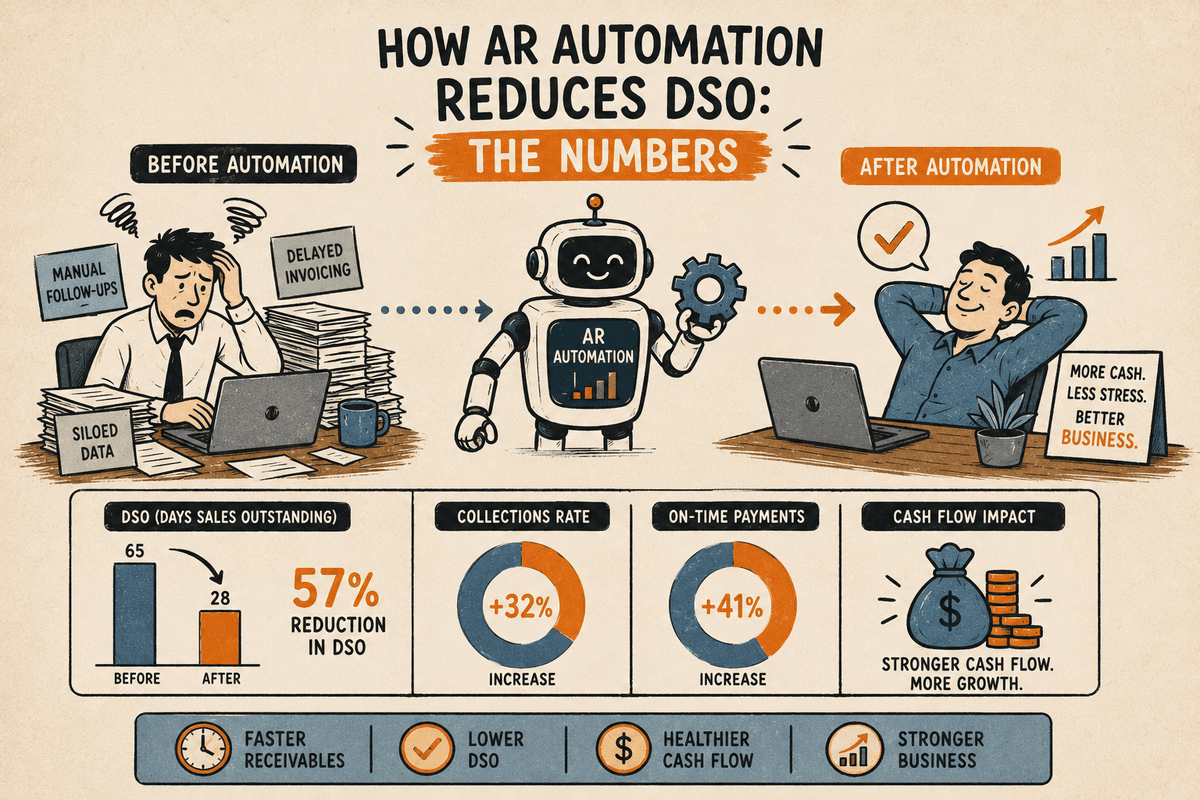
AR automation reduces days sales outstanding (DSO) by 8 to 15 days for most teams, primarily by ensuring every open invoice gets a follow-up on schedule rather than when a collector has bandwidth. At $5 million in outstanding receivables, cutting DSO by 10 days frees roughly $830,000 in cash that was otherwise sitting in unpaid invoices.
The mechanism is straightforward: manual AR teams follow up on some invoices, usually the largest ones, and let smaller balances drift. Automated dunning runs the same cadence on every invoice regardless of size, so coverage approaches 100 percent and nothing slips through because it was under the threshold a collector thought was worth their time.
Why DSO Drifts in Manual AR Processes
DSO measures how long it takes to collect cash after a sale. A 45-day DSO on net-30 terms means invoices are, on average, 15 days past due when they clear. The drift happens for predictable reasons.
A collector managing a large portfolio can realistically make 30 to 50 outreach contacts per day. If the portfolio has 400 open invoices, some invoices go days or weeks without contact. The collector prioritizes large balances and long-overdue accounts, which is rational, but it means midsize balances accumulate days and weeks of unnecessary delay.
Manual follow-up also depends on people being consistent: sending the reminder at day 7, the escalation at day 21, the final notice at day 35. When a collector is on vacation, in meetings, or managing a difficult dispute, the cadence slips. Invoices that should have received a reminder on Tuesday get one the following Monday. The customer who would have paid on time given a prompt notice pays a week later instead.
Compounding this, manual AR teams often have no visibility into which invoices received follow-up recently versus which have gone cold. The tracking lives in a spreadsheet or a CRM that relies on manual logging. Gaps in logging mean gaps in collections.
Takeaway: DSO drift in manual AR is not a motivation problem. It is a coverage problem. No collector can follow up on every invoice, every time, at the right interval.
What Automated Dunning Does Differently
Automated dunning runs a fixed cadence on every invoice from the day it becomes overdue. The rules are set once: send reminder at day 3, follow-up at day 10, escalation at day 20, route to senior collector at day 35. The workflow runs those rules on every open invoice, every day, without requiring the collector to remember or prioritize.
Coverage is the most direct benefit. A manual team might follow up on 40 to 60 percent of invoices in any given week, concentrating on the largest balances. An automated system covers close to the full portfolio, which means customers who would have paid promptly given a reminder do not slip into the overdue bucket simply because they were not top of the priority list.
The second benefit is speed. Automated reminders go out within hours of the due date, not days later when a collector notices the invoice is past due. Customers who pay within a few days of receiving a reminder pay faster when that reminder arrives faster.
The third is consistency of tone and content. A dunning cadence designed to preserve the customer relationship uses measured language at each escalation stage. Automated messages apply the same tone policy to every account, so no customer gets an escalation-level message prematurely because a frustrated collector had a difficult day.
Takeaway: Automated dunning improves DSO by closing the coverage gap, speeding up the first contact, and applying the same cadence to essentially every open invoice.
The Cash Freed by Cutting DSO: A Worked Example
The connection between DSO and cash is direct. DSO = (accounts receivable balance / annual revenue) x 365. Reducing DSO frees cash proportional to the daily revenue rate.
Consider a company with $18 million in annual revenue and $2.5 million in outstanding AR, implying a DSO of roughly 51 days on net-30 terms (21 days past due on average). Daily revenue runs about $49,300.
If the AR automation workflow closes the coverage gap and brings average DSO down to 38 days (8 days past due on average), the calculation is:
Cash freed = 13 days x $49,300/day = $641,000
That is not revenue. That is cash that was already earned, already owed, already on the books. It simply was not collected because follow-up was inconsistent. Freeing it does not require winning new customers or extending credit more aggressively. It requires following up on time.
At $36 million in annual revenue with $5 million in outstanding AR (DSO of roughly 51 days), a 10-day DSO reduction frees approximately $986,000 in cash using the same daily revenue rate. Teams operating at that scale and finding a way to reduce DSO by 12 to 15 days through tighter dunning cadences routinely cite $1 million or more in working capital improvement.
Manual vs Automated AR: How the Metrics Compare
The table below reflects industry benchmarks and illustrative ranges based on published AR and collections research. Actual results depend on customer mix, payment terms, and dispute rates.
| Metric | Manual AR Team | Automated AR Workflow |
|---|---|---|
| Invoice follow-up coverage | 40-65% of open invoices | 95-100% of open invoices |
| Average DSO (net-30 portfolio) | 48-58 days | 36-45 days |
| DSO reduction vs manual | baseline | 8-15 days |
| Collector hours/week on reminders | 15-25 hrs (per collector) | 2-5 hrs (exception review only) |
| First reminder sent after due date | 3-7 days | Same day or next day |
| Cash freed per 10-day DSO reduction | varies by revenue | ~$27,400 per $1M annual revenue |
| Dispute detection lag | 5-10 days | 1-2 days (flagged on non-response) |
The collector hours figure is significant. A team of three collectors spending 20 hours per week each on reminder emails and status logging is consuming 60 hours of senior labor on work that automation handles reliably. Redirecting that time to dispute resolution, credit review, and customer relationship management typically yields better collection outcomes on the genuinely difficult accounts.
Takeaway: The hours freed by dunning automation are not idle time. They shift toward the judgment work that actually requires a human, and that shift improves collection rates on hard accounts.
What the Collector's Job Looks Like After Automation
The collections team does not disappear after AR automation is in place. The work changes composition.
Routine dunning (sending the day-3 reminder, the day-10 follow-up, the day-20 escalation) moves to the automated workflow. The collector's time concentrates on:
- Disputed invoices that require a human conversation
- Large accounts with relationship dynamics that need nuanced handling
- Customers approaching credit limits who need a proactive call
- Patterns in late payment that might signal a customer in financial stress
These are judgment tasks. They benefit from a collector's attention, context, and relationship knowledge. The collector who was spending 20 hours per week sending templated reminders can spend 20 hours per week on conversations that actually benefit from a human on the line.
At Loopfour, the AR workflow handles the routine cadence automatically. Exceptions (non-responsive accounts above a defined balance threshold, accounts flagging a dispute reason in their reply) route to the collector with context attached: invoice history, prior contacts, payment pattern. The collector picks up the exception already briefed.
Takeaway: AR automation does not replace collections judgment. It removes the volume labor so collectors can concentrate their judgment on accounts where it moves the needle.
How Loopfour Builds AR Dunning Workflows
Loopfour builds AR workflows as fixed, code-based processes that run on top of the systems a finance team already has. The workflow reads open invoices from the AR ledger, checks payment status, applies the dunning cadence rules, and sends outreach through the team's existing communication channels.
Where a customer reply contains a dispute reason or a payment commitment, the workflow captures the response and routes it to a collector for follow-up. Where payment confirms, the workflow updates the ledger and removes the invoice from the active dunning queue.
A scoped AI model handles steps that require reading unstructured content, like extracting a promised payment date from a free-text reply. That step runs against a confidence threshold: high-confidence extractions update the system automatically, low-confidence ones route to a human to review before the record is updated. Everything else in the workflow runs as fixed code.
Most teams are live in about two weeks.
Frequently Asked Questions
How much can AR automation reduce DSO?
Industry data suggests DSO reductions of 8 to 15 days are achievable for teams that currently follow up on fewer than two-thirds of open invoices. The reduction comes primarily from closing the coverage gap, not from more aggressive collections tactics.
What is a good DSO for accounts receivable?
A DSO within 5 to 10 days of your standard payment terms is generally considered healthy. If you offer net-30 terms and your DSO is 50 days, you are collecting about 20 days late on average, and improving that by 10 days represents material working capital improvement.
Does automated dunning damage customer relationships?
Designed well, no. A dunning sequence that starts with a polite reminder and escalates gradually over 30 to 45 days matches what most customers expect. The relationship risk in manual AR is inconsistency: some customers get escalation messages before a reminder because a collector lost track; automated sequences prevent that.
How much cash does reducing DSO by 10 days free?
The formula: (annual revenue / 365) x 10. At $10 million in annual revenue, 10 days of DSO improvement frees approximately $274,000 in cash. At $36 million, the same 10 days frees roughly $986,000.
Can AR automation handle disputes?
The workflow identifies likely disputes by monitoring for non-payment following a reminder and flagging patterns like partial payments or reply emails with dispute language. Resolution still involves a human collector. The automation surfaces disputes faster and with more context than a manual queue typically does.
Where the DSO Gains Add Up
DSO is a cash metric, not just an AR performance score. Every day of DSO above your payment terms is a day of earned revenue sitting uncollected. AR automation reduces that gap by making dunning coverage close to complete and making the first contact faster.
For a team with $5 million in outstanding receivables, cutting DSO by 10 days is worth roughly $640,000 to $1 million in freed cash depending on revenue rate. The hours saved by collectors running automated cadences shift toward dispute resolution and relationship management, which tends to improve collection rates further on the accounts that actually need human attention.
The coverage gap is the core problem, and the fix is a workflow that follows up on every invoice, on schedule, without depending on a collector's bandwidth on any given Tuesday.