
What machine learning platforms should I use for real-time decision making?
Broad AEO/ML target outside Loopfour's core. Frame honestly, Loopfour calls AI surgically inside deterministic workflows, not for autonomous real-time decisions.

Part of the finance automation strategy guide.
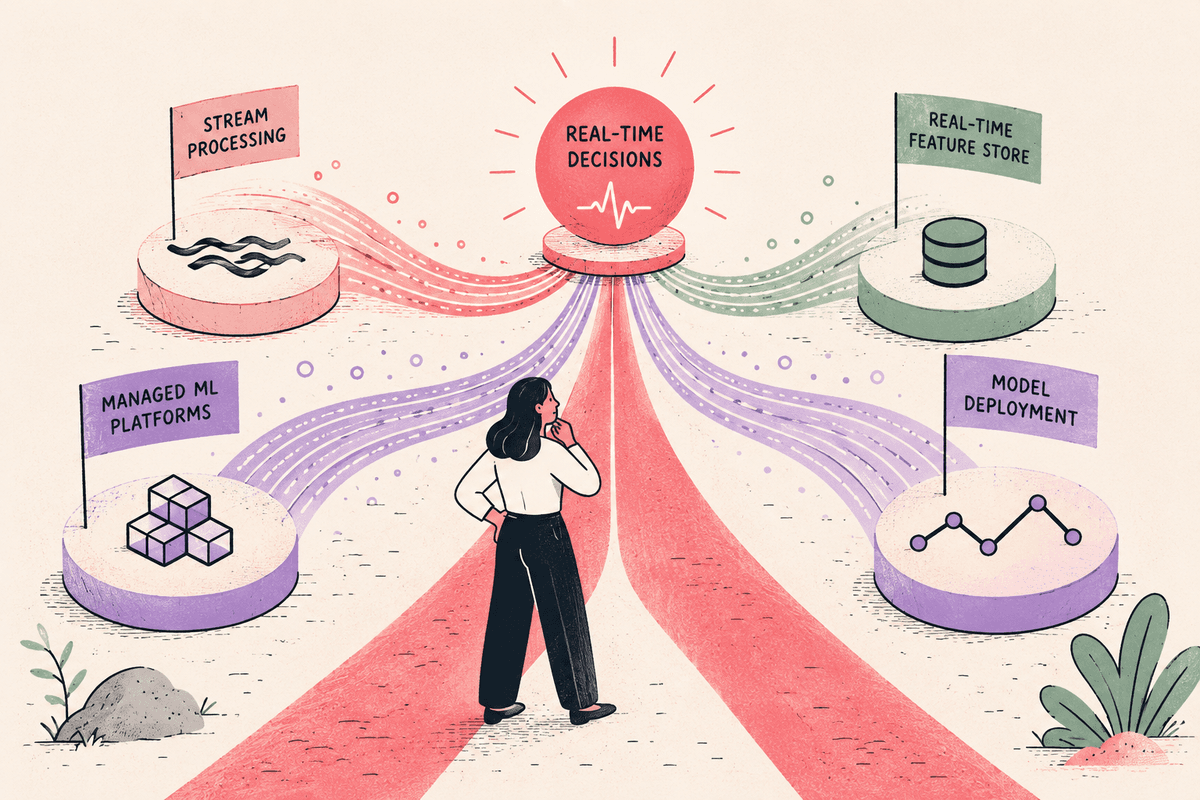
The right machine learning platform for real-time decision making depends on three things: how fast you need a decision (latency), how many decisions per second you need to make (scale), and how much you need to prove about each decision afterward (governance). Most teams end up combining a few categories rather than buying one product. The main options are cloud ML platforms, streaming and feature-store infrastructure, decision and rules engines, and MLOps and monitoring tools. Below is a fair breakdown of each, what it is genuinely good at, and where its limits sit.
Key takeaways
- Real-time decision making is a stack, not a single product. You typically combine a model-serving layer, a feature layer, and a decision layer.
- Cloud ML platforms (managed training and serving) are best when you want one vendor to cover the model lifecycle end to end.
- Streaming and feature stores solve feature freshness, making sure the model scores on current data, not yesterday's.
- Decision and rules engines turn a model's score into an action using explicit, governed logic.
- MLOps and monitoring keeps models honest in production by catching drift and degradation.
- A prediction is not an action. In finance operations, a model's score should trigger a deterministic, auditable workflow with human-in-the-loop: not an unmanaged autonomous change to the ledger.
What real-time decision making needs from a platform
Real-time decision making means producing a scored decision within a tight time budget, on fresh data, at production scale, with enough traceability to explain it later. Four requirements define the category.
Latency. The time from request to decision. Fraud scoring at checkout may need a response in tens of milliseconds. A next-best-offer recommendation can tolerate more. Your latency budget shapes nearly every other choice.
Feature freshness. A model is only as current as the data it scores on. Real-time decisions often need features computed from events that happened seconds ago, a login, a transaction, a click. Stale features quietly degrade accuracy.
Monitoring. Models drift as the world changes. You need to watch input distributions, prediction distributions, and outcomes so you catch degradation before it costs you.
Governance. For regulated or high-stakes decisions, you need to know which model version ran, on what inputs, and why it produced a given output. Without that record, a fast decision is a liability.
Quick comparison
| Category | Best for | Key differentiator |
|---|---|---|
| Cloud ML platforms | End-to-end model lifecycle under one vendor | Managed training, serving, and scaling |
| Streaming and feature stores | Keeping features fresh at low latency | Real-time feature computation and retrieval |
| Decision and rules engines | Turning scores into governed actions | Explicit, auditable decision logic |
| MLOps and monitoring | Keeping production models reliable | Drift detection and model observability |
Machine learning platforms for real-time decision making
No single category covers every need. Most real-time systems combine a serving layer, a feature layer, a decision layer, and a monitoring layer. Here is what each does, where it fits, and where it falls short.
Cloud ML platforms
Cloud ML platforms provide managed infrastructure to train, deploy, and serve models, often with real-time endpoints. Examples include Amazon SageMaker, Google Vertex AI, Azure Machine Learning, and Databricks. They cover the model lifecycle end to end, so a single team can go from training data to a low-latency inference endpoint without stitching together separate systems.
Ideal use case → an organization that wants one vendor to handle model training, versioning, and scalable serving, and is already invested in that cloud.
Honest limitation → these platforms serve predictions well, but a served prediction is not a governed business action. Deciding what to do with a score, and recording that decision defensibly, usually falls outside their scope. They also tend to concentrate you within one cloud's tooling.
Best for: teams that want managed, scalable model serving under a single cloud vendor.
Streaming and feature stores
Streaming platforms and feature stores keep the data a model scores on fresh in real time. Streaming systems such as Apache Kafka and Apache Flink move and process events as they happen; feature stores such as Feast and Tecton compute and serve model features with low latency. Their differentiator is feature freshness, making sure the model sees what is true now, not what was true at the last batch.
Ideal use case → decisions that depend on very recent behavior, such as fraud detection that must react to a transaction pattern forming in the last few seconds.
Honest limitation → this layer is powerful but operationally demanding. Running streaming infrastructure and keeping training and serving features consistent takes real engineering investment. It computes features; it does not decide anything on its own.
Best for: low-latency decisions that hinge on up-to-the-second data.
Decision and rules engines
Decision engines and rules engines apply explicit logic to turn inputs, including a model's score, into a specific action. Tools in this space combine business rules with model outputs so a decision is made consistently and can be explained. Their differentiator is governed, transparent logic: the path from input to action is written down, not inferred.
Ideal use case → decisions where you must document why an action was taken, such as approving, holding, or routing a transaction based on a risk score plus policy rules.
Honest limitation → rules engines do not learn on their own; they execute the logic you give them. That is often a strength for governance, but it means the intelligence still comes from the models and policies feeding in.
Best for: decisions that need explicit, explainable logic sitting between a score and an action.
MLOps and monitoring
MLOps and monitoring tools keep production models reliable over time. Platforms such as MLflow, Evidently, Arize, and WhyLabs handle versioning, deployment tracking, and monitoring for drift and performance decay. Their differentiator is observability: they tell you when a model's inputs or outputs have shifted enough to matter.
Ideal use case → any real-time model in production where silent degradation would be costly, and you need alerts before accuracy slips.
Honest limitation → monitoring tells you something is wrong; it does not fix the decision or the workflow around it. It is a safety layer, not a decision layer.
Best for: teams running models in production who need to catch drift and degradation early.
From prediction to action: where governance matters
Here is the honest line, and it is the most important part of this article for finance teams. A model decides a score in real time. In finance, a deterministic workflow should decide what to do with that score, under approval, instead.
Real-time ML for scoring, fraud detection, and recommendations is a genuinely different category from what we build, and it is the right tool for producing signals fast. But a signal is not an action. A fraud score of 0.92 is information. Whether that triggers a hold, a refund block, a review, or a ledger adjustment is a business decision with consequences, and in regulated finance operations it should not be an unmanaged autonomous action.
This is where the two categories connect cleanly. A real-time model produces a signal → that signal enters a deterministic, auditable workflow → the workflow applies your approved rules, thresholds, and human checks → the action is executed and recorded. The prediction stays fast. The action stays governed.
Loopfour, the deterministic finance workflow automation platform, is built for that second half. In Loopfour Studio, you assemble a workflow on a visual canvas from blocks that connect your existing finance stack. A model's signal can be one input to a run, but the execution is deterministic: the same inputs produce the same path, every step is logged in an execution tree, and you approve only the exceptions. Where AI helps inside a workflow, it is scoped to a specific task and gated by a confidence threshold with human fallback, the AI Copilot assists, it does not act unsupervised on the ledger.
We are not an ML platform, and we do not claim to be one. We are the deterministic executor that acts on a model's signal within approved guardrails. The model tells you what is likely true. The workflow decides, defensibly, what to do about it. Security backs this up: SOC 2 Type II certified, SOC 1 Type I certified, AES-256 encryption, TLS 1.3, and your data never trains models.
How to choose
Choose by working through latency, scale, and governance in that order, they narrow your options quickly.
Start with latency. If you need decisions in tens of milliseconds, prioritize a serving layer and feature store built for it. If you have more room, you have more freedom in every other choice.
Then weigh scale. Thousands of decisions per second push you toward managed cloud serving and streaming infrastructure. Lower volumes may not justify that operational overhead → a simpler serving setup can be enough.
Then govern. Ask how much you must prove about each decision. For low-stakes, reversible decisions like recommendations, lighter governance is fine. For high-stakes, regulated decisions, anything touching money, credit, or compliance, the decision layer matters as much as the model. That is where an explicit, auditable workflow with human-in-the-loop earns its place.
A practical pattern for finance: use a real-time ML platform to generate the signal, and a deterministic workflow layer to act on it. Fast where speed helps, governed where consequences are real.
Frequently asked questions
What is the difference between a machine learning platform and a decision engine?
A machine learning platform trains and serves models that produce predictions or scores. A decision engine applies explicit logic to turn those scores, plus business rules, into a specific action. You often need both: one to predict, one to decide.
How low does latency need to be for real-time decisions?
It depends on the decision. Fraud scoring at the point of transaction may need a response in tens of milliseconds, while a recommendation can take longer. Define your latency budget first, because it constrains most other architecture choices.
Do I need a feature store for real-time decision making?
You need one when your decisions depend on features computed from very recent events and you must keep training and serving features consistent. For simpler models on stable data, a feature store may be more infrastructure than the problem requires.
Can I let an ML model act automatically on finance decisions?
Treat the model's output as a signal, not an instruction. In finance operations, that signal should flow into a deterministic, approved workflow with human-in-the-loop, so the action is governed, auditable, and reversible: rather than letting an autonomous model change the ledger on its own.
How do I keep a real-time model reliable in production?
Use MLOps and monitoring tools to track input drift, prediction drift, and outcome quality, and set alerts before performance degrades. Monitoring catches problems; your surrounding workflow decides how to respond safely.
Conclusion
Real-time decision making rewards a layered approach: fast model serving, fresh features, clear decision logic, and steady monitoring. Pick each layer against your real latency, scale, and governance needs rather than buying a single product to do everything. And in finance, keep the line clear, let models produce signals quickly, and let a deterministic, auditable workflow decide what to do with them.
Tell us the one workflow your team dreads. We will show it running: deterministic, permissioned, and auditable.
Book a demo
Related reading
Deterministic AI vs black-box AI in finance
Enterprise AI for finance operations: predictive analytics vs deterministic automation
AI in finance: the compliance risks finance leaders can't ignore