
How to Automate ASC 606 Revenue Recognition for SaaS and Usage-Based Contracts
Automating ASC 606 revenue recognition means replacing fragile spreadsheets with a deterministic workflow that extracts contract terms, builds recognition schedules, and posts journal entries to your ERP, with AI only where genuine judgment is required.

Part of the revenue recognition guide.
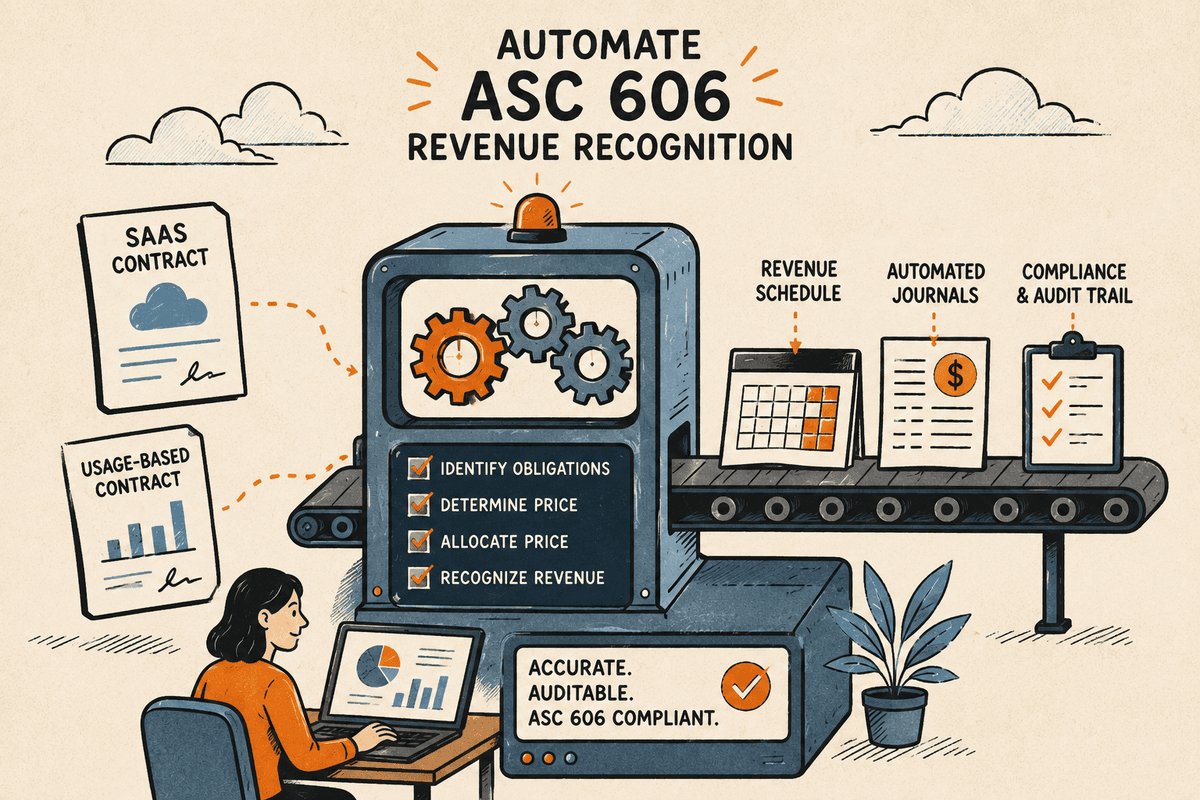
How to Automate ASC 606 Revenue Recognition for SaaS and Usage-Based Contracts
You automate ASC 606 revenue recognition by building a fixed, repeatable workflow that pulls contract terms, applies your allocation and recognition rules in code, and writes the resulting schedules directly into your GL, the same way every time. The spreadsheet nightmare ends not because you use smarter spreadsheets, but because you replace them with logic that cannot drift.
Why Rev Rec Is So Hard to Get Right
Revenue recognition under ASC 606 and IFRS 15 is not a data problem. It is a logic problem layered on top of a data problem.
A standard SaaS contract might bundle a platform license, professional services, and a usage-based tier into one arrangement. Each component is a separate performance obligation with its own recognition pattern. The license might recognize on day one, the services over the implementation period, and the usage component monthly as consumption occurs. Your team has to identify all three, allocate the transaction price across them, and then track each independently through its own recognition schedule.
That gets harder as contracts evolve. Ramp deals defer more revenue in early periods and accelerate later. Contract modifications, where a customer expands seats mid-term or renegotiates pricing, can require either a cumulative catch-up adjustment or a prospective recast of the entire remaining schedule, depending on whether the modification adds a distinct good or service. Most teams make that call in a comment cell in a spreadsheet.
The compounding risk is scale. A team managing 200 contracts with manual schedules might miss one modification, misclassify one performance obligation, or copy-paste the wrong allocation rate. By the time the auditors arrive, the error is buried in a file last touched eight months ago.
The problem is not that accountants are careless. The problem is that spreadsheets are wrong by design for logic that needs to run reliably at scale.
What "Automating Rev Rec" Actually Means
Automation in this context does not mean asking a general-purpose AI agent to read contracts and post journal entries. That approach produces confident-sounding outputs with unpredictable accuracy. What it actually means is building a workflow where every rule-bound step runs in code and every judgment step is handled by a scoped model with a confidence gate.
The workflow has four layers.
Layer 1: Contract data extraction. A scoped AI model reads the executed contract and outputs structured fields: effective date, term, transaction price, list of performance obligations with their standalone selling prices, usage metric definitions, and any ramp or milestone schedules. The model returns a confidence score for each field. Anything below the threshold, say a non-standard usage clause or an unusual modification history, routes to a human reviewer before the schedule is built.
Layer 2: Recognition schedule generation. Once the structured terms are confirmed, deterministic code builds the full recognition schedule. No judgment here. Given a two-year subscription with a ramp, quarterly usage minimums, and a one-time implementation fee, the code produces a row-level schedule showing recognized and deferred amounts for every accounting period across the contract life. The same inputs produce the same schedule, always.
Layer 3: Modification handling. When a contract is amended, the workflow re-runs. It compares the new terms to the existing schedule, applies the correct ASC 606 modification accounting treatment based on whether the modification is distinct, and generates a revised schedule with the required catch-up or prospective adjustment flagged explicitly.
Layer 4: ERP posting. The confirmed schedules roll up to journal entries and post to your existing ERP on the close calendar. No manual entry, no copy-paste from a schedule tab to a journal template.
Every step is traceable: you can follow any journal entry back to the contract term that produced it.
The Human-in-the-Loop Is Not an Afterthought
Finance teams worry, reasonably, that automation means removing human judgment from decisions that require it. The design here does the opposite.
The confidence threshold is the key mechanism. When the AI model reads a contract and finds a performance obligation it cannot classify with high confidence, such as a customization commitment that might or might not be distinct, it does not guess. It flags the field, surfaces the relevant contract language, and queues the item for a human reviewer. The reviewer makes the call, the decision is recorded, and the confirmed classification flows into the schedule.
This is a maker-checker structure applied to contract interpretation. The model makes a first pass. The human checks the uncertain cases. The code runs the schedule on confirmed inputs. Each party does what they are actually good at.
In practice, teams find that 80 to 90 percent of their contracts are standard enough that the model classifies every field above the confidence threshold. Reviewers spend their time on the genuinely ambiguous cases, which is where their expertise creates real value, not on re-entering data that a machine could read accurately.
Removing human review entirely would be reckless. Routing every contract through manual review regardless of complexity is just expensive.
How the Schedule Runs into Your Existing ERP
One common objection is that building recognition schedules is only half the problem. The other half is getting them into the GL without creating a new reconciliation problem.
Loopfour is built to run on top of the systems a finance team already uses. The workflow does not replace your ERP or your billing system. It reads from them and writes to them. Recognition schedules post as journal entries via your ERP's standard API or file import, formatted to match your existing chart of accounts and cost center structure.
The close process looks like this: billing events and contract data flow in from your billing and CRM systems, the workflow generates and reconciles the schedules, exceptions go to the reviewer queue, and the confirmed entries post to the GL. The team's close calendar shrinks because the mechanical work runs automatically at period end, not on a spreadsheet that someone opens the morning of day two.
A team that previously spent days pulling contract data, rebuilding schedules, and entering journals can run the same process in hours, with the reviewer time concentrated on the exceptions that actually need it.
The integration is not a project. The workflow is typically live in roughly two weeks.
What the Numbers Look Like: Manual vs. Automated
The table below uses illustrative figures drawn from patterns common in mid-market SaaS finance teams. They are not specific Loopfour customer metrics; treat them as a realistic comparison scenario for a team managing roughly 500 active contracts.
| Metric | Manual (spreadsheets) | Automated workflow |
|---|---|---|
| Hours to build recognition schedules (monthly) | 40-60 hours | 4-6 hours (review only) |
| Days to close revenue | 5-7 days after period end | 1-2 days after period end |
| Contracts handled per analyst | 80-120 | 400-600 |
| Restatement / error risk | High (manual entry, formula drift) | Low (rules fixed in code) |
| Modification catch rate | Dependent on analyst memory | Every contract change triggers a re-run |
| Auditor prep time | 2-3 days assembling support | Hours (schedule-to-entry trace is built in) |
The headline number for most teams is not the compliance posture, though that matters. It is the three to five days recovered from the close calendar every month, and the ability to double the contract volume an analyst can handle without hiring.
For a team targeting a five-day close, moving rev rec off spreadsheets is usually the highest-leverage thing they can do.
What IFRS 15 and Multi-Entity Stacks Add to the Problem
Companies reporting under both ASC 606 and IFRS 15 face largely parallel rules, but the operational burden compounds when you have multiple entities, currencies, or jurisdictions. A single contract with a US parent and a European subsidiary may require parallel recognition schedules under both standards, with FX translation applied consistently.
In a spreadsheet environment, that usually means two separate files that someone maintains in parallel and reconciles quarterly. In a workflow environment, the same contract terms generate both schedules from a single source of truth, with currency and standard as parameters, not separate files.
The reproducibility here is what makes consolidation tractable. When every entity's recognition schedule is generated from the same logic with the same inputs, the intercompany eliminations are consistent and the consolidated view is a function of the data, not a manual assembly exercise.
Multi-entity rev rec is where spreadsheet entropy compounds fastest, and where fixed workflow logic pays off most.
The Close Gets Shorter Before the Audit Gets Easier
There is a tendency to frame automation in revenue recognition around the audit. Traceable schedules, defensible allocations, clean support packages. All of that is real. But the first benefit a finance team actually experiences is a shorter, less chaotic close.
When the recognition schedules are built automatically at period end, the team stops spending the first three days of the close doing mechanical work and starts spending them reviewing results. Analysts move from builders to checkers, which is both a better use of their time and a more reliable process.
At higher contract volumes, the capacity math changes materially. A team of three analysts managing 350 contracts manually is running at the edge of what is sustainable. The same team running an automated workflow can handle 1,500 contracts without adding headcount. That is not a governance story. That is a growth story.
Loopfour was built for finance teams who are growing faster than their processes were designed to support. The goal is a close that stays predictable as the contract count climbs, not a close that requires two more hires every time ARR doubles.
If your rev rec process does not scale with your contract volume, the spreadsheet is the ceiling.