
How to Automate Accounts Receivable and Collections so DSO Drops Without Adding Headcount
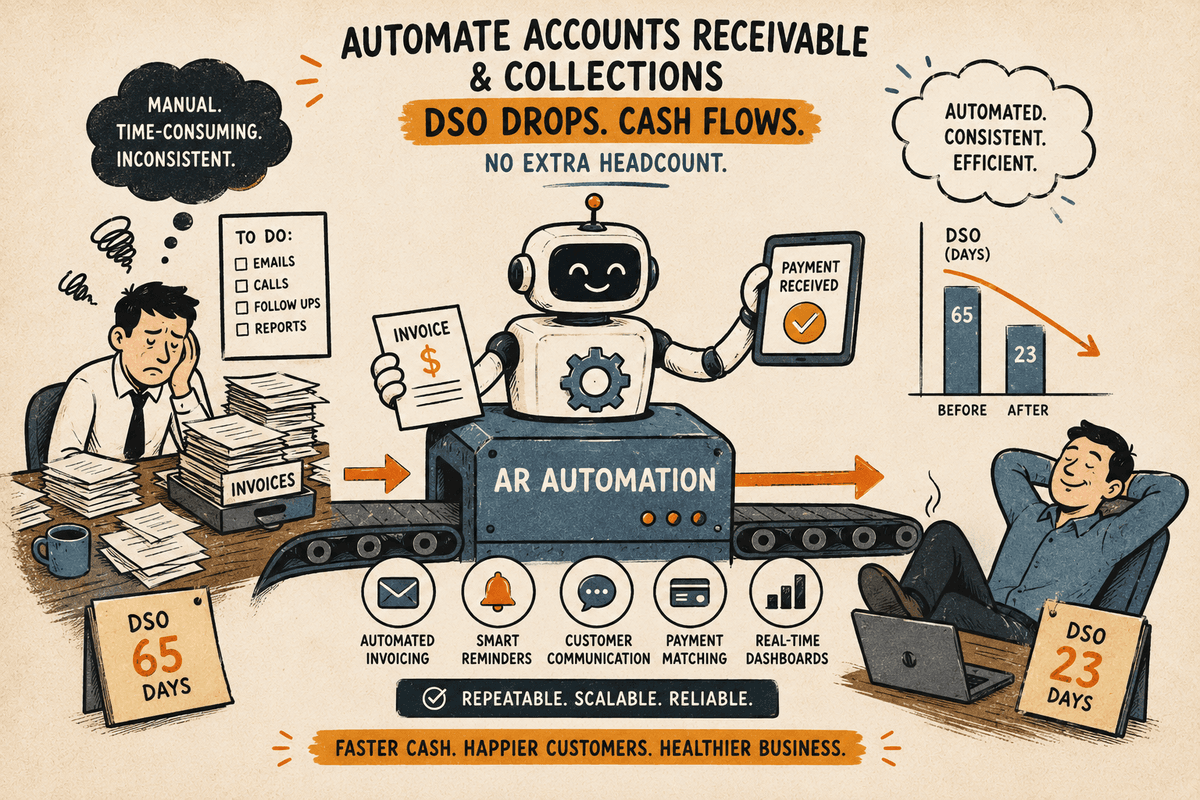
AR and collections automation replaces inconsistent manual follow-up with a repeatable dunning cadence that runs identically for every overdue account, shrinking DSO by days and freeing collectors to handle exceptions rather than routine reminders.

Part of the accounts receivable and collections guide.
How to Automate Accounts Receivable and Collections so DSO Drops Without Adding Headcount
AR and collections automation replaces inconsistent manual follow-up with a repeatable dunning cadence that executes identically for every overdue account. The result is a measurable drop in days sales outstanding (DSO) and a significant reduction in collector time spent on routine reminders, without a single new hire.
What AR and Collections Automation Actually Means
At its core, AR automation is about making the follow-up process predictable. Every invoice that ages past its due date enters a defined sequence of actions: a reminder goes out on day one, a follow-up on day seven, a more direct message on day fifteen, and an escalation to a manager on day thirty. The same logic, the same timing, the same routing, every single time.
That sounds simple. In practice, most finance teams don't have it. They have a shared inbox, a spreadsheet with aging buckets, and a collector who manually reviews what needs to go out today. When that collector is busy, on leave, or simply has too many accounts to touch, follow-ups slip. When they slip, DSO climbs.
Collections automation closes that gap by encoding the dunning cadence in workflow logic rather than leaving it to individual judgment.
Takeaway: AR automation isn't about removing the human. It's about making sure routine follow-up never depends on whether a human happens to get to it.
The Manual Pain Points Driving DSO Creep
Talk to any AR manager and you'll hear the same complaints. Follow-up timing varies by collector. Some prefer a softer approach, others go straight to the formal notice. Neither approach is wrong, but inconsistency makes it impossible to know what's actually working.
Forgotten follow-ups are the biggest culprit. A team processing 3,000 invoices a month can't manually track every aging account without something falling through. One missed reminder on a large invoice can add two or three weeks to DSO on that account alone.
Escalations are awkward. When a collector needs a manager involved, they usually send a Slack message or walk over to someone's desk. There's no record, no defined approval path, and no way to know if the escalation actually happened. Disputes get mixed into the same queue as routine overdue accounts, slowing everything down.
The result is that DSO creep isn't usually caused by customers refusing to pay. It's caused by inconsistent outreach that lets payment slip down their priority list too.
Takeaway: Most DSO problems trace back to process gaps, not customer intent. Fixing the process fixes the cash.
How a Deterministic Dunning Cadence Works
A well-built AR automation workflow is reproducible by design. The logic runs on run number one the same way it runs on run number ten thousand. There's no fatigue, no judgment call about whether this customer "seems like they'll pay," and no forgotten step.
Here's what a typical cadence looks like in practice:
- Day 0: Invoice issued, payment terms recorded, due date locked.
- Day 1 past due: Automated reminder sent from the AR team's email address, including invoice number, amount, and payment link.
- Day 7 past due: Second reminder with a slightly more direct subject line. No manual intervention needed.
- Day 15 past due: Third outreach flags the account as at-risk internally and copies the account owner in the CRM.
- Day 30 past due: Escalation task created and routed to the AR manager via a defined approval path, with full account history attached.
- Day 45 past due: Account flagged for potential collections handoff or write-off review, with documentation complete for bad-debt provisioning.
Each step is logged. Every email sent, every escalation triggered, every exception routed to a human: all of it is traceable in the system. If a dispute comes in, the workflow pauses that account's dunning sequence and routes it to the right team for resolution. When the dispute closes, the cadence resumes from the correct point.
This is the same-every-run consistency that manual processes can't offer.
Takeaway: A fixed cadence eliminates the variability that lets overdue accounts age unchecked. Every account gets the same treatment, every time.
Where AI Helps (and Where It Hands Off)
Scoped AI has a real role in AR automation, but it's narrower than vendors usually claim. The right use is for steps where human judgment was doing pattern recognition on text, not for replacing the workflow logic itself.
Two clear examples:
Drafting context-aware reminders. A generic "your invoice is overdue" message gets ignored. A reminder that references the customer's payment history, mentions their usual payment method, and uses the right tone for the relationship performs better. An AI model can draft that variation given the right inputs, and a collector can approve or tweak it in seconds rather than writing it from scratch.
Classifying disputes. When a customer replies to a reminder with a complaint, the message needs to be categorized: is this a pricing dispute, a delivery issue, a duplicate invoice claim, or just a delay request? An AI model can read the email and classify it with a confidence score. If confidence is high, it routes automatically to the right team. If confidence is low, it goes to a human for review. That keeps disputes out of the general AR queue without requiring a person to triage every reply.
Everything else in the cadence, the timing, the escalation paths, the approval routing, runs on deterministic logic. No model is deciding when to escalate or whether to write off a balance. Those are workflow decisions defined by the finance team and enforced consistently.
Takeaway: AI earns its place in AR when it handles text-heavy judgment steps with a human in the loop for anything uncertain. The workflow logic stays predictable.
The Numbers: Before and After Automation
The impact of a properly built AR automation workflow shows up in a few key metrics. The table below uses illustrative figures for a finance team processing roughly 2,500 invoices per month, based on patterns common to companies in the $10M to $100M revenue range.
| Metric | Before Automation | After Automation |
|---|---|---|
| DSO (days) | 48 days | 33 days |
| Invoices with at least one automated follow-up | ~40% | 100% |
| Collector hours per week on routine outreach | 18 hours | 4 hours |
| Average time to first follow-up (past due) | 4.2 days | Same day |
| Bad debt as % of revenue | 1.4% | 0.8% |
| Dispute classification time per ticket | 12 minutes | Under 2 minutes |
A 15-day reduction in DSO on $5M in monthly revenue frees roughly $2.5M in working capital that was previously sitting in unpaid receivables. That's cash that can fund operations, reduce credit line usage, or simply sit in the bank instead of on an aging report.
The collector hour reduction is equally significant. Fourteen hours a week recovered per collector is more than a third of a full-time role. That capacity goes toward exception handling, relationship management on strategic accounts, and dispute resolution, the work that actually requires judgment.
Takeaway: A 15-day DSO improvement on $5M in monthly revenue unlocks $2.5M in working capital. That's the real payoff of collections automation.
How Loopfour Builds This in Practice
Loopfour builds AR and collections automation as fixed, auditable workflow code that runs on top of the systems a finance team already uses: their ERP, their billing platform, their CRM, their email infrastructure. The team doesn't replace any existing tool. The workflow layer connects them.
Loopfour engineers scope and build the dunning cadence based on the customer's existing collection policy. If the policy says escalate at 30 days, the workflow escalates at 30 days, with a maker-checker approval step where required. If a dispute comes in, the workflow pauses, classifies, and routes. If the customer pays, the cadence closes cleanly with a log entry.
The finance team's job is to approve exceptions, review escalations, and make judgment calls on disputes. Routine follow-up runs without them. Teams are typically live in about two weeks.
Takeaway: Loopfour doesn't ask the finance team to learn a new tool. It builds the automation around the systems they already trust.
What Changes When Every Account Gets the Same Follow-Up
The practical effect of consistent dunning isn't just DSO reduction. It changes the dynamic with customers. When a customer knows that an overdue invoice will generate an automatic follow-up the next day, they're less likely to let it slide. The informal "we can usually get away with paying late" relationship disappears when the process is predictable.
It also changes what the AR team is doing all day. Instead of manually reviewing aging buckets and drafting reminders, they're handling the accounts that genuinely need attention: large balances in dispute, strategic customers with complex payment situations, accounts flagged for potential write-off. The work becomes higher-leverage and more interesting.
Finance teams that have deployed this kind of automation consistently describe the same shift: the AR function stops being reactive and starts being proactive. When the cadence runs automatically, the team has time to look ahead, analyze payment patterns, and surface risks before they become bad debt.
Takeaway: Consistent follow-up doesn't just collect faster. It changes how customers think about your payment terms and how your team spends its time.
The Path Forward
DSO reduction is one of the highest-leverage improvements a finance team can make, and it doesn't require a headcount increase to get there. It requires making the follow-up process predictable, removing the dependence on individual memory and judgment for routine steps, and routing genuine exceptions to the right humans with full context already attached.
AR and collections automation does exactly that. The dunning cadence runs the same way every time. Disputes get classified and routed without clogging the main queue. Escalations follow defined paths with documentation built in. And the metrics, DSO in days, collector hours, bad-debt rate, become levers the team can actually pull rather than numbers they watch deteriorate.
If your AR process is built around a shared inbox and a spreadsheet, the gap between where you are and where you could be is probably measured in weeks of DSO and hundreds of hours of collector time per year. That's the problem Loopfour is built to close.