
What a finance automation implementation actually looks like, week by week
Discovery through first live workflow, with realistic timelines and what the finance team is actually responsible for at each step.
By Zuny
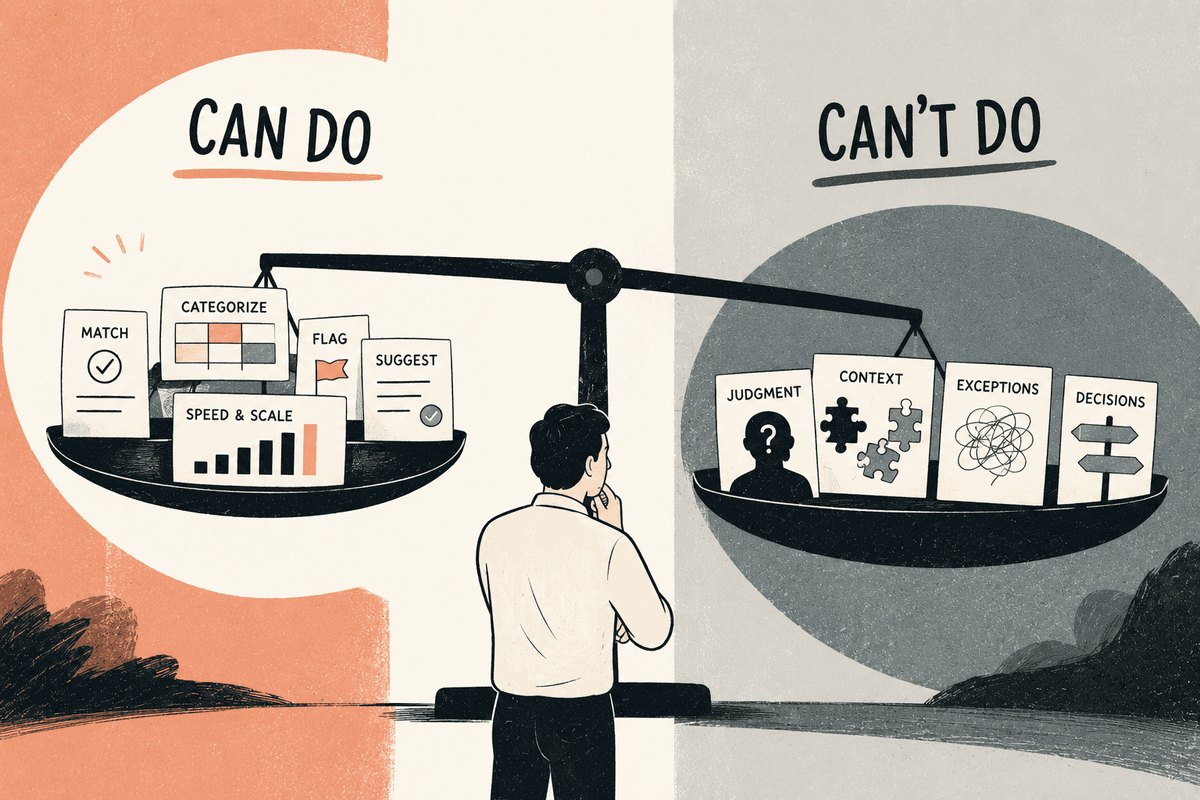
A finance automation implementation with Loopfour runs about six weeks from first call to first live workflow. Your finance team spends roughly 12 to 20 hours across those six weeks; we do the build, the testing, and the monitoring. The work splits into six stages: discovery, access and security review, canvas build, parallel run, exception tuning, and cutover. Every timeline and hour figure below is a typical range or an illustrative scenario, not a guarantee; your numbers move with workflow complexity and how fast IT issues credentials. The most common reason a six-week implementation becomes a ten-week one is not the software. It is a decision nobody has made yet.
Key takeaways
• A typical first workflow goes live in six weeks. Multi-entity setups and heavily customised NetSuite instances take longer.
• Your team's total time commitment usually falls between 12 and 20 hours, concentrated in Week 0 discovery and Week 4 parallel-run approvals.
• Access and security review is the step buyers underestimate most. Credentials and permission scoping cause more delay than the build.
• Most slippage originates on the customer side, and almost all of it is preventable before kickoff. Loopfour is SOC 2 Type II certified with a SOC 1 audit underway, so security evidence exists before procurement asks.
• Go-live is not the end of the work. We monitor runs, review exceptions, and repair workflows when a source system changes.
The six-week implementation timeline at a glance
Here is the week-by-week shape of a first Loopfour implementation. Treat the hours as a typical range for one workflow of moderate complexity, not a commitment. The exit criterion matters more than the date: each week ends when a condition is met, not when the calendar says so.
| Week | What happens | Who does it | Your team's hours | Exit criterion | | --- | --- | --- | --- | --- | | Week 0 | Discovery interviews, workflow selection, sample documents | Loopfour, your controller, one process owner | Three to five | Workflow chosen, with volume and cycle time written down | | Week 1 | Security review, API credentials, permission scoping | Your IT admin; Loopfour supplies evidence | One to three | Loopfour authenticates to every source system, read-only | | Weeks 2 and 3 | Build on the canvas in Loopfour Studio, logic review | Loopfour builds; your controller reviews | Three to four | Controller signs off on logic, rules, thresholds | | Week 4 | Parallel run against the manual process, no live writes | Loopfour operates; your team approves | Three to five | Agreed match rate reached against manual output | | Week 5 | Exception tuning, confidence thresholds, sub-workflows | Loopfour tunes; your team rules on edge cases | Two to three | Exception volume stable, every type owned | | Week 6 | Cutover to live writes, monitoring handover | Loopfour; your controller attends | One to two | Writing to production, monitoring active |
Why finance automation timelines are hard to compare
Vendor timelines differ because vendors measure different things. Some count from contract signature, some from the first working session. Loopfour, the deterministic finance workflow automation platform, measures from the first discovery call to the first workflow writing to your production systems without a human retyping anything. That definition is stricter, so our timeline looks longer than some. It also survives contact with an actual close. Two factors move the number more than anything a vendor controls: how much of your process exists only in someone's head, and how fast your IT team issues credentials.
Week 0: discovery and workflow selection
Week 0 is two or three working sessions in which we document one workflow end to end and agree on what "correct" means. It costs your team three to five hours and determines most of what follows.
We interview the person who runs the process, not only the person who owns it, and collect 20 to 50 sample documents including the ugly ones. Those define the exception rules we build in Weeks 2 and 3.
Workflow selection matters most. A good first workflow has meaningful volume, a knowable set of rules, and an owner who can settle edge cases within a day. Invoice intake into QuickBooks, NetSuite, Xero, Sage Intacct, or Rillet is a common first choice.
Exit criterion: one workflow chosen, with monthly volume, connected systems, current cycle time, and a named exception owner written down.
Week 1: access, security review, and how long it really takes
Week 1 covers API credentials, permission scoping, and your vendor security questionnaire. Buyers underestimate this step most, because the calendar cost comes from your ticket queue rather than from technical work.
The technical work is small. Connecting Loopfour to QuickBooks, Xero, Stripe, Salesforce, HubSpot, Attio, Slack, Gmail, Outlook, DocuSign, PandaDoc, Dropbox Sign, or Workday is usually an afternoon. NetSuite and Sage Intacct take longer because permissions are more granular. Four questions set the pace:
• Service account or named user? Use a dedicated service account. Named-user authentication breaks when that person changes roles, and the audit trail then attributes machine actions to a person.
• How tightly is the role scoped? We ask for the minimum permission set the workflow needs. In NetSuite that means a custom role, a small task for your administrator.
• Does SSO apply? Your team signs in to Loopfour Studio through SSO. The workflow's system access uses API credentials, a separate grant. Confusing the two adds days.
• Who signs off on the security questionnaire? This is the queue that stalls. Loopfour is SOC 2 Type II certified, holds a SOC 1 audit in progress, and operates HIPAA controls. Data is encrypted with AES-256 at rest and TLS 1.3 in transit, and never used to train models. That evidence exists before procurement asks, which turns a long review into a document exchange.
Exit criterion: Loopfour authenticates to every source system, in sandbox or read-only mode, with a scoped service account.
Weeks 2 and 3: build on the canvas and logic review
We build the workflow on the canvas in Loopfour Studio, using the AI Copilot to draft and debug blocks, while your controller reviews the logic twice. Your team spends three to four hours across the two weeks, reading and correcting rather than building.
A workflow is assembled from blocks — 30 of them across seven categories — on a canvas. A typical invoice intake workflow flows: Gmail or Outlook inbox → document parsing → vendor and purchase-order match in NetSuite → tolerance check → Slack approval for exceptions → bill created in NetSuite → execution tree written to the run log.
AI is called for one scoped task at a time. The Invoice Agent extracts named fields from a document — vendor, invoice number, date, line items, totals — and returns a confidence score for each. Below your configured confidence threshold, the run stops and routes to a named human approver in Slack, Gmail, or Outlook. The Receipt Agent and Contract Agent work the same way. The extraction is scoped; the decision to accept it is yours.
Everything around the extraction is deterministic. The same input produces the same output on run number 1 and run number 1,000,000, and every action lands in an execution tree you can inspect. Loopfour is not an AI agent with a wrapper, and the practical difference is that you can predict what the workflow will do before it runs.
That matters given what reasoning models still get wrong. On the FinanceReasoning benchmark published at ACL 2025 (arXiv:2506.05828), the strongest reasoning model reached 89.1% on the hard subset, and numerical calculation errors made up roughly 37.5% of failures. So we do not ask a model to compute your totals. Arithmetic, matching, and posting run in deterministic code. Where a system has no API, we fall back to browser automation and name the steps that depend on it.
Exit criterion: your controller signs off on the logic, the exception rules, and the approval thresholds.
Week 4: the parallel run
In Week 4 the workflow runs against real data alongside your manual process, with no writes to production systems. Your team approves runs and compares output for three to five hours across the week.
The parallel run produces evidence, not reassurance. We compare automated output against manual output line by line and agree a match rate before cutover. Disagreements are the useful part: each exposes a rule that was never written down.
Published benchmarks describe the gap you are testing against. Levvel Research puts manual cost per invoice at $10 to $15 against $2 to $3 automated, and IOFM puts the manual invoice error rate at roughly 2% against below 0.8% automated. Your parallel run shows which end of those ranges applies to your process.
Exit criterion: the agreed match rate is met, and every mismatch has a documented cause.
Week 5: exception tuning
Week 5 adjusts confidence thresholds, exception rules, and sub-workflows so the exception queue is small, stable, and owned. Your team spends two to three hours ruling on ambiguous cases.
Expect exceptions to persist. Ardent Partners reports that over 60% of invoices still require some human interaction, and no honest vendor will tell you that number goes to zero. The goal is that exceptions arrive pre-assembled — document, match attempt, and reason for the stop in one place — routed to the person who can settle them.
Exit criterion: exception volume is stable week over week and each exception type has a named owner.
Week 6: cutover and monitoring handover
Cutover switches the workflow from parallel to live writes, and we hand over the monitoring view and escalation path. Your controller attends a handover session of one to two hours. Cutover is deliberately boring: nothing in the logic changes, only the write step turns on. If output diverges, we revert to parallel mode and fix the rule.
Exit criterion: the workflow writes to production, monitoring is active, and your team knows who to contact and how fast we respond.
What your finance team is actually responsible for, in hours
Plan for 12 to 20 hours in total across the six weeks, with Week 0 and Week 4 the heaviest. These are illustrative ranges for one workflow of moderate complexity.
| Responsibility | When | Who | Typical hours | | --- | --- | --- | --- | | Discovery interviews | Week 0 | Controller and the person who runs the process | Two to three | | Collecting sample documents | Week 0 | Accounts payable or receivable staff | One to two | | Defining exception rules and thresholds | Weeks 0 and 2 | Controller or Head of Finance | Two to three | | Reviewing workflow logic on the canvas | Weeks 2 and 3 | Controller | Two to three | | Approving and comparing in the parallel run | Week 4 | Approver on rotation | Three to five | | Ruling on ambiguous exceptions | Week 5 | Exception owner | Two to three |
Two of those rows cannot be delegated to us. Defining exception rules and reviewing workflow logic require someone who knows your business. We propose rules from your sample documents, but only your controller can confirm that a three-way match tolerance of $50 is right for your vendors. We also avoid scheduling sessions during your close week.
Why implementations slip
Implementations slip for a handful of recurring reasons, and most sit on the customer side. That is not a complaint. It is the most useful thing we can tell you before you buy, because each cause has a cheap prevention.
| Cause of slippage | Whose side | How to prevent it | | --- | --- | --- | | Process was never documented, so requirements shift mid-build | Customer | Write the current process down in Week 0, including who overrides what | | The person who knows the exceptions is on leave or in close | Customer | Name a primary and a backup exception owner before kickoff | | ERP permission change needs an IT ticket that sits in a queue | Customer | File the credential ticket in Week 0 with the scoped role attached | | Pilot workflow chosen for visibility rather than fit | Shared | Pick volume and knowable rules over executive attention | | An open decision blocks the build, such as a dunning cadence | Customer | List unmade decisions in Week 0, each with an owner and a date |
The pattern is consistent: delay comes from missing decisions and missing access, not from build time. When you arrive with a documented process, a scoped service account, and an exception owner who answers within a day, six weeks holds.
What "live" actually means
Live means the workflow writes to your production systems on its own schedule, your team touches only exceptions, and Loopfour monitors every run. It does not mean the work stops. Three things continue after go-live, as part of the managed service:
• Monitoring. We watch runs for failures, latency, and drift in exception volume. You see the same execution tree we do.
• Exception review. We review exception patterns with you on a set cadence and propose rule changes when a case recurs.
• Maintenance when your systems change. QuickBooks, NetSuite, Xero, Sage Intacct, Rillet, Salesforce, HubSpot, and Workday all ship changes. When an API version, a field, or a screen changes, we repair the workflow. You should not be the one who finds a broken integration during close. A tool hands you a canvas. A managed service owns the workflow's continued correctness.
How to decide whether you are ready to start
You are ready when you can answer four questions in writing. If you cannot, those answers are the real project, and they take days rather than weeks.
| Question | Ready | Not ready yet | | --- | --- | --- | | Which single workflow, and what monthly volume? | One named workflow with a document count | Five candidates, unranked | | Who owns exceptions, and who backs them up? | Two names, available in the build weeks | The controller, in principle, during close | | Can IT issue a scoped service account in your ERP? | Yes, ticket filed | Unknown, no ticket | | What decisions are still open? | Listed, each with an owner and a date | Thresholds and cadences still under debate |
One more question is worth asking internally. Which is the more expensive problem: cycle time or error rate? Manual invoice cycle time averages 14.6 days against three to five days automated, so a cycle-time problem argues for automating intake first. An error-rate problem argues for matching and posting first. Your answer changes the pilot workflow, not the timeline.
APQC research across more than 10,000 organizations finds top performers close in five days or less, median six days, while bottom performers take 10 or more calendar days. If your close sits at the bottom of that range, the gap is a process gap before it is a software gap.
Frequently asked questions
How long does a finance automation implementation take?
A first workflow typically goes live in about six weeks, measured from the first discovery call to the workflow writing to your production systems. High-volume workflows with clear rules land sooner. Multi-entity setups, customised NetSuite or Sage Intacct instances, and undocumented processes take longer. This is a typical range, not a guarantee.
How many hours does the finance team have to spend on workflow automation onboarding?
Plan for 12 to 20 hours in total across six weeks for one workflow of moderate complexity. The heaviest weeks are Week 0 discovery and the Week 4 parallel run, at three to five hours each. These are illustrative ranges.
What causes finance automation implementations to run late?
Most delay comes from the customer side: an undocumented process that shifts mid-build, an unavailable exception owner, an ERP permission ticket stuck in a queue, a badly chosen pilot workflow, or an open decision such as a dunning cadence. File the credentials ticket and name a backup exception owner before kickoff, and the common causes disappear.
Does the security review slow things down?
It slows down reviews where evidence has to be produced on request. Loopfour is SOC 2 Type II certified with a SOC 1 audit underway, operates HIPAA controls, encrypts data with AES-256 at rest and TLS 1.3 in transit, and never uses customer data to train models. Because that evidence already exists, the step is usually a document exchange rather than a multi-week investigation.
What happens if a workflow gets something wrong?
Every run produces an execution tree recording each action and its inputs, so you can see where the workflow diverged. Where AI extracts fields from a document, a confidence threshold routes low-confidence results to a named approver in Slack, Gmail, or Outlook before anything posts. If a rule is wrong, we change it and re-run.
Does anything change after go-live?
Yes, on our side. We monitor runs, review exception patterns with you, and repair workflows when a source system such as NetSuite, Xero, or Workday changes an API or a screen. Your team reviews exceptions only.
What to do next
Loopfour is in Early Access, with white-glove onboarding, free during the beta, no credit card required. The most useful next step is not a demo. It is a conversation about which of your workflows fits the criteria above, and whether the decisions behind it have been made. Bring one process and its ugly documents, and we will give you a realistic timeline, including the parts that depend on your team.
Book a workflow review.