
Series A to Series C: how finance automation needs change at each stage
What to automate at each stage of scale, and which automation decisions become expensive to unwind later.

Part of the month-end close guide.
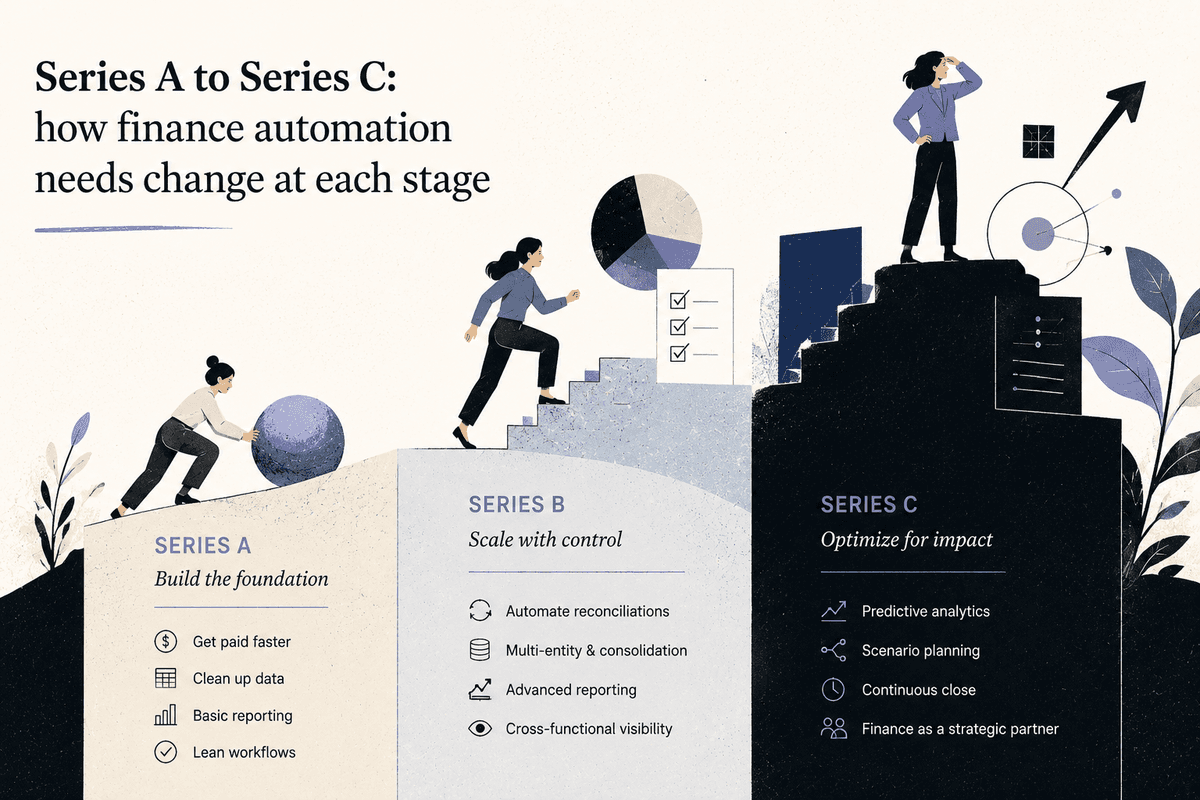
Finance automation needs change at each stage because the binding constraint changes. At Series A the constraint is the finance lead's hours: one or two people carry bookkeeping, invoicing, collections and board reporting. At Series B it is close reliability, as volume rises and entities multiply. At Series C it is auditability, and the cost of proving what happened. Automate against the current constraint and you buy back capacity. Automate against the wrong one and you buy a migration project. This guide maps each stage to what to automate now, what to defer, and three decisions that are painful to unwind two rounds later.
Key takeaways
• The binding constraint changes at every stage, and the right automation follows the constraint rather than the org chart.
• Series A rewards automating contract-to-cash and basic AR, so the finance lead stops re-keying signed deals into QuickBooks or Xero.
• Series B rewards close discipline, cash application at volume and three-way match, anchored against the APQC median close of six days.
• Series C rewards evidence that scales: an audit trail produced by the system, not assembled by a person.
• Three decisions compound badly: chart of accounts design, entity and consolidation structure, and where your automation logic lives.
• Logic you cannot export becomes a migration project exactly when you have no time for one.
Finance automation by stage at a glance
The table below maps each stage to its constraint and the work that pays back fastest. Read the "defer" column as carefully as the "automate now" column.
| Stage | Finance team shape | Binding constraint | Automate now | Defer | Typical systems | | --- | --- | --- | --- | --- | --- | | Series A | One finance lead, often the first finance hire, plus an outsourced bookkeeper | The finance lead's hours | Invoicing from signed contracts, basic AR and dunning, receipt capture, simple revenue schedules | Multi-entity consolidation, SOX-style controls, procurement workflows | QuickBooks or Xero, Stripe, a CRM such as Salesforce, HubSpot or Attio, Gmail or Outlook, Slack | | Series B | Controller plus one or two analysts, first accounting manager | Close reliability and multi-entity complexity | Cash application at volume, AP three-way match, bank reconciliation, cross-system sync, close checklists | Full ERP customisation, predictive forecasting, procure-to-pay suites | NetSuite, Sage Intacct or Rillet, Stripe, Salesforce, DocuSign or PandaDoc, Slack | | Series C | VP Finance or CFO, controller, AR and AP specialists, FP&A | Controls, auditability and the cost of proving what happened | Segregation of duties, approval routing, evidence capture, ASC 606 revenue recognition, DSO monitoring | New systems duplicating an existing system of record | NetSuite or Sage Intacct, Workday, Salesforce, Stripe, DocuSign, Dropbox Sign |
Why stage matters more than headcount
Stage predicts finance automation needs better than headcount. Two companies with the same team size face different constraints depending on contract complexity, entity count and audit exposure. Map yourself to the constraint that hurts most this quarter, not to the round you last announced.
Early on, finance is a capacity problem. In the middle it becomes a reliability problem. Later it becomes an evidence problem. A tool that solves capacity — a script, a Zapier chain, a spreadsheet — rarely survives the reliability stage, because it cannot prove what it did.
Two numbers frame the stakes. Levvel Research puts the manual cost per invoice at $10 to $15, against $2 to $3 when the process is automated. Ardent Partners finds that over 60% of invoices still require some human interaction. That gap is where stage-appropriate automation lives: you are not removing people from the process, you are removing them from the parts that need no judgement.
Series A: the constraint is the finance lead's hours
At Series A the finance function is usually one person, sometimes supported by an outsourced bookkeeper. That person owns the close, invoicing, collections, board reporting and every ad hoc request from the CEO. The constraint is their calendar.
What the finance function looks like
Finance runs on a small stack and a large amount of context held in one head. Contracts are signed in DocuSign, PandaDoc or Dropbox Sign. Revenue lands in Stripe. The ledger is QuickBooks or Xero. Customer data sits in Salesforce, HubSpot or Attio, and the two rarely agree.
What to automate now
Automate the paths between systems that the finance lead walks by hand every week. Three pay back first.
• Invoicing from signed contracts. The step-flow is DocuSign → contract terms extracted → invoice created in QuickBooks or Xero → confirmation posted to Slack. Loopfour's Contract Agent extracts named fields — customer, term, billing frequency, amount — and routes anything below the confidence threshold to a person for approval before the invoice is created.
• Basic AR and dunning. Overdue invoices trigger a sequenced reminder from Gmail or Outlook, with escalation to the account owner in Slack. The finance lead approves the escalation list, not each message.
• Bookkeeping hygiene. Receipt capture, categorisation and matching against the bank feed. Loopfour's Receipt Agent handles extraction; ambiguous items land in an exception queue for review.
If your contracts are multi-element — a platform fee plus services plus usage — build revenue schedules now. ASC 606, the FASB five-step model governing revenue recognition under US GAAP, does not become easier to apply retroactively.
What to explicitly defer
Defer multi-entity consolidation until you have a second entity. Defer formal control matrices until an auditor asks. Defer procurement workflows until approval routing saves more time than it costs. Building these early creates maintenance work against the one constraint you cannot relax.
The failure mode to avoid
The Series A failure mode is automation that lives in one person's head: a spreadsheet with nested formulas, a Zapier chain nobody documented, a script on a laptop. It works until that person takes a holiday. Loopfour, the deterministic finance workflow automation platform, keeps the logic on a visual canvas where every block is inspectable and every run produces an execution tree. The workflow survives the person who commissioned it.
Series B: the constraint is close reliability
At Series B the close starts slipping and nobody can say why. Volume has grown past the point where exceptions can be handled from memory. Entities have multiplied. The first external audit is on the horizon, and the team is often mid-migration to NetSuite, Sage Intacct or Rillet.
What the finance function looks like
A controller now owns the close, supported by one or two analysts. Cash application takes days because remittance data arrives by email, in bank files and inside Stripe payouts, in three different formats. AP has enough volume to need three-way match. Intercompany entries appear and are handled by hand.
The number to anchor against
APQC, drawing on data from more than 10,000 organizations, finds that top performers close in five days or less, the median sits at six days, and bottom performers take 10 or more calendar days. If your close runs past 10 days at Series B, the problem is rarely effort. The close depends on people remembering the order of operations.
What to automate now
• Cash application at volume. Bank file or Stripe payout → remittance parsed → payment matched to open invoices in NetSuite or Sage Intacct → unmatched items queued for review. Partial payments, short pays and consolidated remittances reach the exception queue with candidate matches attached.
• AP three-way match. Purchase order, receipt and invoice compared automatically; only mismatches reach a human. Loopfour's Invoice Agent extracts line items and flags variances above a set tolerance, and the approver sees the extracted values beside the source document.
• Bank reconciliation and cross-system sync. Keep Salesforce, Stripe and the ERP in agreement continuously rather than at month end.
• Close checklists with named owners. Every task, dependency and piece of evidence in one run.
Error rates now matter more than cost per transaction. IOFM puts the manual invoice error rate at roughly 2%, falling below 0.8% when automated. At Series A that is a handful of corrections. At Series B it is a reconciliation problem that surfaces during your first audit.
What to explicitly defer
Defer heavy ERP customisation. Customisations written during a migration block upgrades and resist documentation. Defer predictive forecasting until your actuals close reliably; a forecast built on a nine-day close inherits the noise. Defer procure-to-pay suites while your vendor count is measured in dozens.
Why deterministic execution matters here
Reliability is the whole point of a Series B close. A process that produces a different result on different runs cannot be reconciled. Loopfour executes workflows programmatically: the same workflow behaves identically on run number one and run number 1,000,000. AI is called for scoped tasks — extracting fields from a remittance advice, classifying a payment reference — with a confidence threshold and a named human fallback.
The FinanceReasoning benchmark (ACL 2025, arXiv:2506.05828) evaluated models across 2,238 finance problems. The strongest reasoning model reached 89.1% on the hard subset, and numerical calculation errors accounted for roughly 37.5% of failures. Extraction and classification suit a model. Arithmetic in your ledger does not.
Series C: the constraint is controls and auditability
At Series C the question changes from "did we get it right" to "can we prove it, repeatedly, to a third party." Controls, segregation of duties and SOX readiness move to the top of the list.
What the finance function looks like
A VP Finance or CFO leads a team with a controller, AR and AP specialists and an FP&A function. Systems have accumulated: an ERP, Workday for people data, Salesforce for pipeline, several point tools bought during Series B. Consolidation is the standing pain.
The market context
Protiviti's 2025 SOX survey found that nearly 70% of organizations have implemented automated compliance tools, and 68% are prioritising more technology and automation. Your auditors have seen automated evidence from your peers. Screenshots and email threads now read as the exception.
What to automate now
• Segregation of duties inside the workflow. The person who creates a credit memo should not approve it. Encode that as an approval step, not a policy document.
• Evidence capture on every action. Every Loopfour run produces an execution tree: which block fired, with what inputs, what the output was, who approved it and when. That is the artefact an auditor wants, generated as a by-product of the work.
• Revenue recognition under ASC 606. Contract terms → performance obligations → schedules in the ERP, with human review at the allocation step.
• Systems consolidation and DSO monitoring. Retire duplicate systems of record. Keep one.
What to explicitly defer
Defer new systems that duplicate something you already own. At Series C the fastest win is removing a tool, not adding one. Defer bespoke reporting layers until consolidation is stable.
Three decisions that are painful to unwind two rounds later
Some decisions are cheap now and expensive later. These three compound quietly, and each becomes a project at the moment you have no capacity for one.
Chart of accounts design
Restructuring your chart of accounts at Series A costs an afternoon. After two years of history it costs a remapping exercise, restated comparatives and a conversation with your auditor about consistency. Design for the reporting you will need at Series B: department, entity, product line and geography as dimensions rather than account-code suffixes. Keep the account list short and push detail into dimensions, which can be added without breaking prior periods.
The common mistake is encoding department into the account number. It reads cleanly at 30 accounts and becomes unmanageable at 300.
Entity and consolidation structure
How you set up intercompany early determines how bad your Series C close is. Two questions decide most of it. Does each entity have its own ledger, or do you run one ledger with a class dimension? Are intercompany transactions recorded as they happen, or reconstructed at period end?
Reconstructed intercompany is the pattern that hurts. It works with two entities and fails at five, and by then you have years of entries to unpick. Record intercompany at the transaction level from the first day you have a second entity, even when that entity is dormant.
Where your automation logic lives
Most teams make this decision by accident. Automation logic ends up in one of three places: a person's spreadsheet, a vendor tool you cannot export from, or a system where the logic is explicit and portable.
The first two fail the same way. When you migrate from QuickBooks to NetSuite, the logic has to be rebuilt from scratch, and the person who knew what it did has moved on.
Ask every automation vendor one question before you sign: if we leave, what exactly do we get back? A usable answer names the artefacts — workflow definitions, field mappings, run history, approval records — and the format. Anything less specific is a lock-in cost you have not priced.
A framework for deciding what to automate next
Work through these four questions in order. The first "no" is your answer.
| Question | If yes | If no | | --- | --- | --- | | Does this task run at least weekly? | Continue | Automate something else first | | Is the rule stateable in writing without using the word "usually"? | Continue | Document the rule first, then revisit | | Does an error here surface within one close cycle? | Automate with an exception queue | Automate with mandatory human approval | | Will an auditor ask how this was done? | Require an execution tree and approval records | Standard logging is sufficient |
Two tests apply at every stage. Automate the path, not the task: moving data between DocuSign, your ERP and Slack pays back more than speeding up a single step. And keep a human on every judgement call. Loopfour routes exceptions to a named approver, so your team reviews the items that need a decision rather than the ones that do not.
Frequently asked questions
When should a startup hire its first finance person versus automate?
Hire when the work needs judgement; automate when it needs consistency. The first finance hire should spend their time on pricing, cash planning and board reporting. If they are re-keying signed contracts into QuickBooks or chasing invoices by hand, the automation decision came too late. Venture-backed teams commonly reach that point during Series A.
What should we automate first at Series A?
Contract-to-cash. The step-flow from a signed DocuSign contract to an invoice in QuickBooks or Xero to a payment in Stripe touches every system and runs on every deal. It is high frequency, rule-based and easy to verify. Basic AR and dunning follows, because collections is the highest-value use of automation when cash is scarce.
How long should a Series B close take?
APQC data from more than 10,000 organizations puts the median close at six days, top performers at five days or less, and bottom performers at 10 or more calendar days. A Series B company with clean systems should target six to eight days. Past 10 days, look at cash application and intercompany before adding headcount.
Do we need to migrate to NetSuite at Series B?
No. Migrate when QuickBooks or Xero stops supporting something you need — multi-entity consolidation, multi-currency, or revenue schedules under ASC 606 at volume. Migrating early costs a quarter of controller time. Migrating late costs the same during audit prep. The trigger is a capability gap, not a round.
How do we automate finance workflows without creating audit risk?
Require deterministic execution and a complete record. Loopfour runs workflows programmatically, so behaviour is identical across runs, and every action produces an execution tree showing inputs, outputs, approvals and timestamps. Where AI is used, it is scoped to a defined task such as extracting invoice line items, with a confidence threshold and a human approver on anything below it. Loopfour is SOC 2 Type II certified, with a SOC 1 audit underway and HIPAA controls in place. Data is encrypted with AES-256 at rest and TLS 1.3 in transit, and never used to train models.
Is this just an AI agent with a wrapper?
No. An AI agent produces a different result on different runs, which no auditor will accept. Loopfour executes deterministic workflows built on a visual canvas, where each block does one defined thing. AI is called surgically — document extraction, classification, matching suggestions — always with a confidence threshold and a human approver. The Invoice Agent, Receipt Agent and Contract Agent read documents. They do not decide treatment.
Where this leaves you
Stage does not change the goal. It changes the constraint. At Series A you buy back the finance lead's hours. At Series B you buy a close you can trust. At Series C you buy evidence that stands up to a third party. The decisions carrying across all three — chart of accounts, entity structure, and where your logic lives — deserve more thought than they usually get.
Loopfour builds, monitors and maintains these workflows on the finance stack you already run. Your team approves the exceptions. Loopfour Studio is in Early Access with white-glove onboarding, free during beta, no credit card required.
Book a workflow review, and we will map your current constraint to the two workflows worth automating first.