
Deterministic vs Probabilistic: Why Finance Can't Run on a Model That Guesses
Finance automation has to produce the same output every run. Here's why repeatable, provable workflows beat general-purpose AI agents for AP, AR, revenue recognition, and the close, what it does to your close time and error rate, and where AI still belongs.

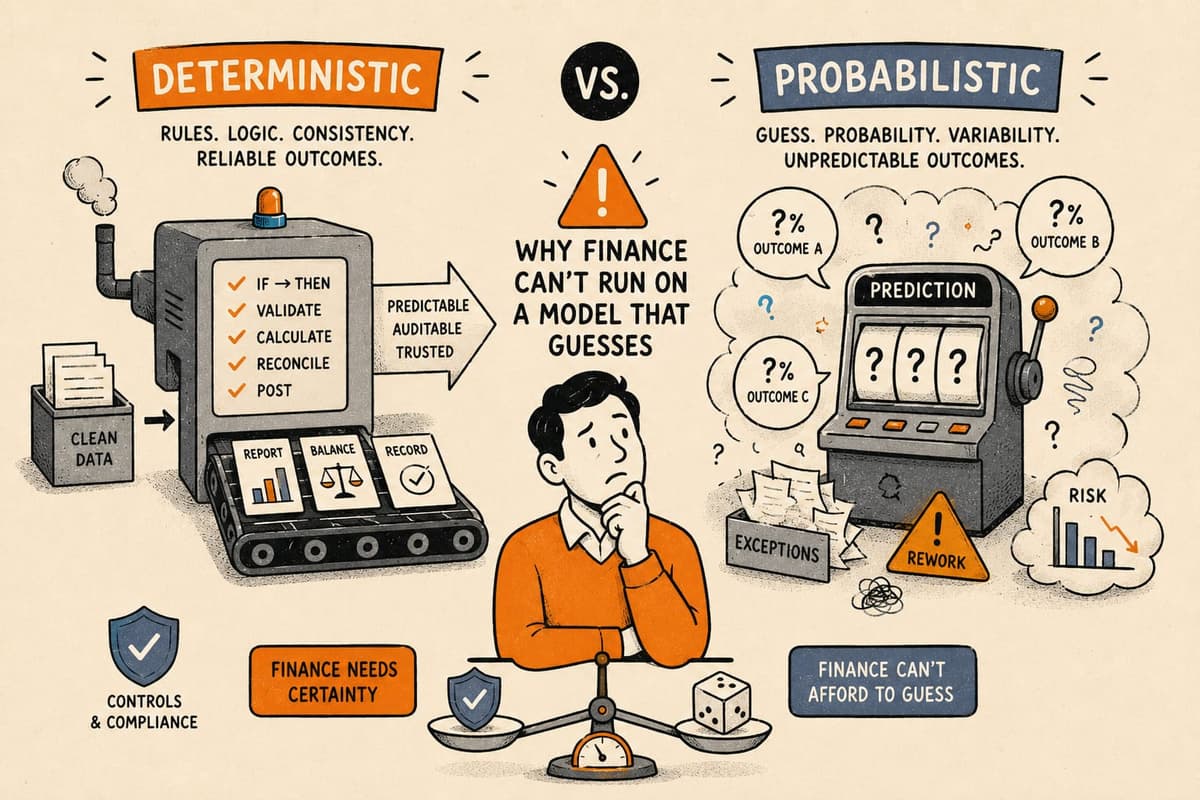
Finance automation has one hard requirement that most AI tools quietly fail: run #1 and run #1,000,000 must produce the same output from the same inputs. A general-purpose AI agent can't promise that, because it decides what to do at runtime and the decision can drift. A workflow built as fixed code can, because the steps are written down and a model is only called for the narrow judgment calls, with anything uncertain handed to a person.
That is the whole argument. Everything below is the detail that makes it real: why "same every time" is worth money, what a probabilistic agent quietly costs you, and the one place AI genuinely earns its seat inside a finance workflow.
The two words that decide everything: deterministic vs probabilistic
A deterministic system, given the same input, returns the same output every time. Sort a list, apply a tax rule, match a payment to an invoice by reference number: same in, same out, forever.
A probabilistic system samples from a distribution. Large language models work this way by design. The same prompt can produce different actions on different days, and that flexibility is the entire point when you're drafting a memo or exploring a dataset.
Here's the trap. The flexibility that makes an AI agent brilliant at exploration becomes a liability in operations. A month-end close that runs a little differently each time isn't "adaptive." It's a variance you now have to chase down and explain.
Takeaway: Match the tool to the job. Sampling for thinking; fixed steps for running.
What "same every run" actually saves you
Start with the number every finance leader already tracks: days to close. A team closing in eight to ten business days is spending most of that window on manual matching, chasing exceptions, and re-checking work that a machine did inconsistently the first time.
When the repetitive 90% of that work runs the same way every cycle, the close stops being a fire drill and becomes a review. You're not rebuilding the schedule each month; you're approving the handful of things that genuinely need a human eye. Teams that move high-volume matching and posting onto repeatable workflows routinely pull multiple days out of the close, and the days they keep are spent on judgment, not janitorial work.
Now put a dollar figure on errors. A misapplied cash receipt or a duplicated invoice isn't just a correction; it's the downstream time to find it, the customer email, the re-issued statement, and the credibility hit when it surfaces in a board deck. A process that produces the same result every run doesn't just catch fewer errors; it stops manufacturing new ones. Consistency is the cheapest error-reduction program a finance team can buy, because the errors it prevents never enter the ledger in the first place.
Takeaway: The first win isn't compliance. It's a shorter close and fewer corrections, which is time and money a CFO can see on a page.
Why controllers care about "reproducible"
There's a second win, and it lands hardest with whoever owns the numbers. Consider a mid-market SaaS team running a monthly revenue recognition close across roughly 2,000 active contracts.
| Dimension | Probabilistic AI agent | Repeatable workflow |
|---|---|---|
| Same output, same input | Not guaranteed; varies run to run | Guaranteed by design |
| Reprocessing a disputed month | Re-run may not reproduce the original result | Re-run reproduces the exact original result |
| Evidence for a review | Conversation logs, often local, not export-ready | A per-run audit trail: what ran, what data, what output, who signed off |
| Changing the logic safely | Re-prompt and hope | Versioned, with a way back |
| When something is unusual | Silent drift you find later | Flagged and routed to a person |
The row that matters most is the second one. When someone asks "show me exactly how you recognized this contract in March," a repeatable workflow replays March. A probabilistic one hands you a transcript and a shrug. That difference is the whole reason regulated work wants a machine that doesn't improvise.
Takeaway: Reproducibility is the difference between reproducing a result and reconstructing an argument for it.
Where probabilistic automation quietly breaks
Four failure modes show up again and again when teams try to run real operations on a general-purpose agent:
- The evidence lives on a laptop. Desktop AI agents often store their activity locally and outside any central, exportable system. For a regulated workload, that is not an audit trail; "the record is on someone's machine" is not a record.
- It can't reliably repeat itself. The same instruction plays out differently across runs. Fine for a first draft, disqualifying for anything that touches the ledger.
- Nothing supervises the work. No second set of eyes before it runs, no version history, no limit on who can change the logic. Those are the first three things any reviewer asks about.
- It leaves when the operator leaves. When the one person who "knows the prompt" is on vacation or gone, the process and its context walk out with them.
None of this is about the model being weak. A frontier model is extraordinary. It's about the model running without any structure around it.
Takeaway: The risk isn't capability. It's what happens around the capability.
The part everyone gets wrong: this is not anti-AI
The argument for fixed steps gets misread as "don't use AI for finance." Wrong. The right design uses AI exactly where judgment is genuinely required and nowhere else.
Reading a contract to classify a performance obligation? That's judgment, so call a reasoning model. Interpreting a messy vendor description or an ambiguous memo line? Also judgment, so call the model. But gate it: attach a confidence threshold, and route anything below the line to a person instead of letting the model guess and move on.
Everything around that judgment step stays plain code: the trigger that detects a signed contract, the extraction of structured terms, the schedule written into your ERP, the routing, the record. The model is a scoped subroutine, not the operator.
A useful rule of thumb: if a status code or a database field already answers the question, plain code answers the question. Reserve the model for real ambiguity in unstructured input, which is exactly where it shines.
Takeaway: Put the intelligence inside guardrails. A predictable shell with a smart core, not the reverse.
What this looks like across the finance stack
The same pattern repeats regardless of workflow:
- AP automation. Rule-based ingestion, matching, and posting; AI only to read the unstructured invoice and classify line items, with low-confidence documents handed to a person.
- AR and collections. A fixed dunning cadence that runs identically for every overdue account, the same reminder logic on run #1 and run #10,000, with escalations following defined paths.
- Revenue recognition. ASC 606 schedules built from extracted contract terms; AI reads the contract, code builds the schedule, the controller reviews the exceptions.
- Reconciliation and close. Rule-based matching across systems; AI only for the genuinely ambiguous residual, everything else matched by fixed logic.
Consider an illustrative AP example: a team processing 3,000 invoices a month lets fixed logic handle the clean, well-structured majority the same way every time, and reserves human attention for the fraction flagged as ambiguous. The exact split depends on your data quality. The point is that the routine volume runs hands-off and the same way twice, so the team's hours move from processing to reviewing.
Takeaway: A predictable shell with scoped AI isn't one feature. It's the operating pattern for every finance workflow worth automating.
Where is finance automation heading?
The market spent 2024 and 2025 asking "can an AI agent do this?" The answer turned out to be yes, and that was the wrong question. The better one is "can it do this the same way every time, fast enough to shorten the close, with a record I can hand to a reviewer?" That question sorts the tools that belong in exploration from the ones that belong in production.
If you're evaluating finance automation, stop grading demos on how clever the agent looks. Grade them on three things a CFO and a controller both care about: does it cut close time, does it cut errors, and can it prove what it did. Bring the workflow you're tempted to hand to a general-purpose agent and ask to see it run the same way twice, on your own stack. The tools built for finance will show you. The ones built for exploration will change the subject.
That's the line. Keep the sampling tools for thinking. Run your finance operations on something that doesn't guess.
Takeaway: The winning question isn't "can AI do this?" It's "can it do this the same way every time, faster than we close today, with a record we can defend?" Grade every tool on that, and the shortlist sorts itself.