
Deterministic AI vs black-box AI in finance: which survives the audit?
Differentiator / comparison. Core determinism-vs-black-box argument for a skeptical finance audience.

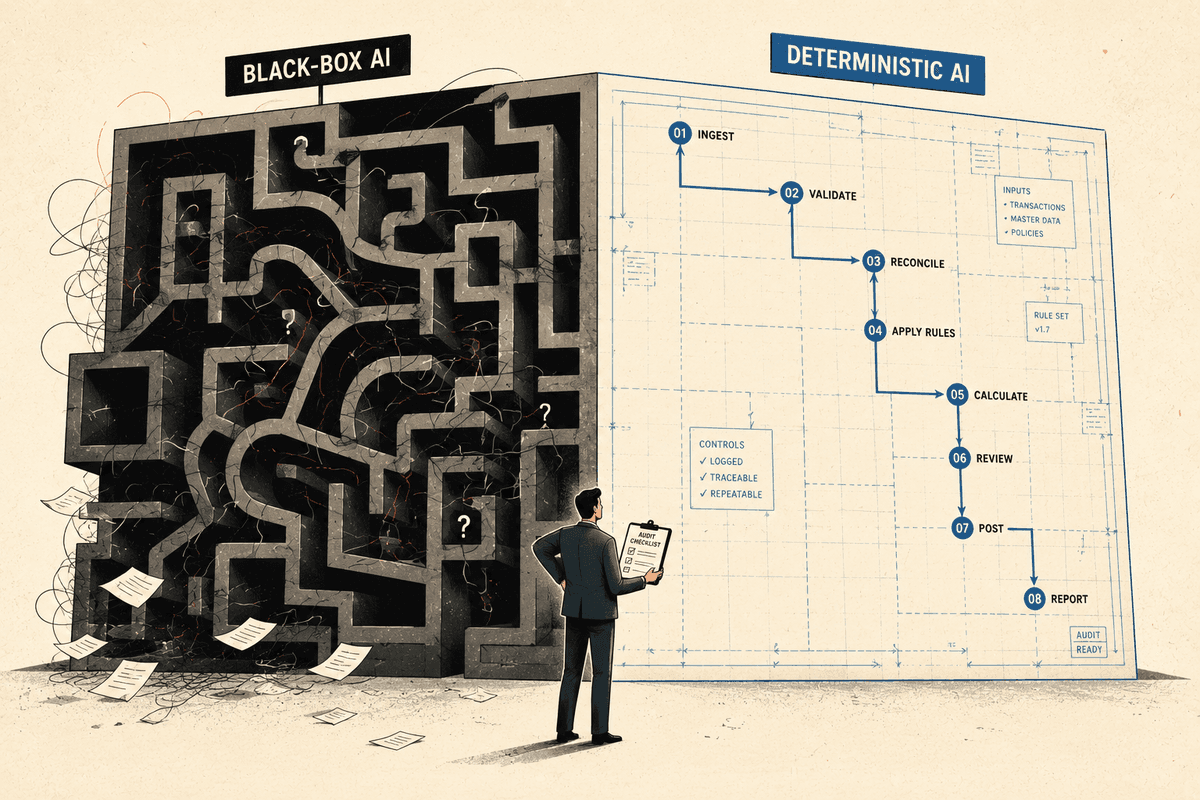
Your board wants AI in finance. Your auditors want it to hold up. Those two demands feel like they pull in opposite directions, but they do not have to. The version of AI that survives the audit is deterministic: automation that runs approved code the same way every time and produces a complete record of what happened. A black-box model decides at runtime. Deterministic automation runs approved code instead. One is easy to trust after the fact. The other asks your auditor to take its word for it. For a finance system of record, that difference decides everything.
Key takeaways
- Deterministic automation is reproducible by design. The same inputs produce the same result on run #1 and run #1,000,000, and the steps are recorded.
- Black-box AI decides at runtime, so it is hard to reproduce and hard to audit. The same prompt can yield a different answer, and the reasoning is not preserved as evidence.
- Probabilistic AI is genuinely excellent at scoped tasks like reading a contract, extracting an invoice, or drafting a summary. That strength is real and worth using.
- The problem is not the model. The problem is letting an unmanaged agent be the system of record. An AI agent decides what to do at runtime. Loopfour does only what was approved.
- The safe pattern is surgical AI inside guardrails: scoped model calls, confidence thresholds, and a human approval step for exceptions, all captured in an execution tree.
- When you decide for your own stack, ask one question: can you reproduce and explain any single run to an auditor without trusting a model's memory?
Deterministic AI vs black-box AI, defined
Deterministic automation runs predefined, approved code that produces the same output for the same input every time, with each step recorded. Black-box AI is a probabilistic model that decides what to output at runtime, so its results can vary and its internal reasoning is not preserved as an audit record. The distinction is not about intelligence. It is about whether the behavior of your finance workflow is fixed and inspectable, or generated fresh on each run.
Where black-box AI genuinely shines
Probabilistic AI is the right tool when the input is unstructured and the task is judgment, not record-keeping. This is where large language models are strongest, and it would be dishonest to pretend otherwise.
Give a modern model a 40-page vendor contract and ask it to find the auto-renewal clause, and it will do in seconds what a person does in twenty minutes. Ask it to read a messy PDF invoice and pull the line items, the tax, and the total, and it handles layouts no rigid parser could. Ask it to draft a variance narrative, summarize a thread of approvals, or classify a stack of receipts, and it performs well.
These are unstructured reasoning tasks: reading, extracting, drafting, summarizing, classifying. The work benefits from a model that generalizes across formats it has never seen. For scoped, bounded tasks with a human reviewing the result, probabilistic AI is a genuine advantage. We build on exactly this strength. The disagreement starts only when the same model is handed the keys to the system of record.
Why black-box AI struggles as a finance system of record
Black-box AI struggles as a finance system of record because the three things an auditor needs most, reproducibility, a complete trail, and reliable error detection, are the three things a runtime-deciding model does not guarantee. Each gap is specific.
Reproducibility. A deterministic workflow that posts a journal entry will post it identically every time the inputs match. A model asked the same question can answer differently across runs, across model versions, or after a silent provider update. When an auditor asks "would this have happened the same way in March," a black-box answer is a guess.
Auditability. An audit trail has to show what happened and why. A model produces an output, but its reasoning is not a durable record you can hand to a reviewer. You can log the prompt and the response, but the decision itself lives in weights you cannot inspect. A black-box model decides at runtime. Deterministic automation runs approved code instead, and that code is the evidence.
Silent errors. A rigid rule fails loudly: the amounts do not reconcile, the run stops, someone is notified. A probabilistic model can fail quietly and confidently, producing a wrong number that looks exactly like a right one. In finance, the confident wrong answer is the dangerous one, because nothing flags it for review. An unmanaged agent that mis-categorizes an expense does not know it was wrong, and neither do you until the quarter closes.
None of this is an argument against the model's intelligence. It is an argument against making an unmanaged agent the place where your numbers officially live.
How deterministic automation uses AI without the risk
Deterministic automation uses AI surgically: the model is called only for the scoped step where it excels, inside guardrails, with a confidence threshold and a human approval point, and every step is written to an execution tree. The intelligence stays. The unpredictability does not.
Loopfour, the deterministic finance workflow automation platform, runs on this pattern. In Loopfour Studio, you build a workflow visually on a canvas, connecting your existing finance stack: QuickBooks, NetSuite, Stripe, Salesforce, Slack. Most blocks execute programmatic, deterministic code: real logic that behaves identically on run #1 and run #1,000,000. When a step genuinely needs judgment, reading a contract, extracting an invoice, the workflow calls an Agent Block, which uses a Claude-class model for that one scoped task and nothing more.
That call is wrapped in controls. A confidence threshold decides whether the model's output is trusted automatically or routed to a person. A human-in-the-loop approval step means you review the exceptions rather than every transaction. And the execution tree records the full run: which blocks fired, what the model returned, what a person approved, in what order. That record is the audit trail, produced as a byproduct of how the system works.
We do not replace Claude's intelligence. We put it inside guardrails. Modern models are brilliant assistants, and we use them where they are strong. The difference is control: an AI agent decides what to do at runtime. Loopfour does only what was approved. The model reads and extracts. The deterministic workflow decides and records.
Side-by-side: which survives the audit
The clearest way to see the difference is dimension by dimension. For a finance system of record, deterministic automation wins on everything an auditor tests; black-box AI wins where the task is unstructured reasoning under human review.
| Dimension | Black-box AI (unmanaged agent) | Deterministic automation |
|---|---|---|
| Reproducibility | Output can vary run to run and across model versions | Identical output for identical input, run #1 to run #1,000,000 |
| Audit trail | Prompt and response logged; the decision itself is not inspectable | Complete execution tree of every step, decision, and approval |
| Error handling | Can fail silently and confidently | Fails loudly; mismatches stop the run and notify a person |
| Control | Decides what to do at runtime | Does only what was approved |
| Best-fit tasks | Reading, extracting, drafting, summarizing, classifying | Posting, reconciling, routing, approving, recording |
The table is not a verdict against AI. It shows that each approach has a home. The mistake is putting the probabilistic tool in the deterministic tool's seat, letting a model that is great at reading a contract also be the authority on what gets posted to the ledger.
How to decide for your finance stack
Decide by separating the two kinds of work in your workflow: the reading and the recording. Wherever the task is interpreting unstructured input, a scoped model call under human review is a strong fit. Wherever the task is the official record, what posted, what reconciled, what was approved, you want deterministic execution and a complete trail.
A few practical questions to run each workflow through:
- Can you reproduce any single run months later, exactly, without trusting a model's memory? If not, that step should be deterministic.
- Would this survive an auditor asking to see every decision? If the answer depends on logs of prompts rather than a record of actions, tighten it.
- Does a wrong output fail loudly or quietly? Anything that can fail silently in finance needs a human control point.
- Is the AI scoped to one bounded task, or is it deciding the whole workflow? Scoped is fine. Deciding the workflow is where the risk concentrates.
This is the line Loopfour is built on. A black-box agent asks you to trust the run. Deterministic automation lets you prove it. You approve the exceptions, the model handles the reading, and the execution tree holds the evidence.
Frequently asked questions
Is deterministic automation just an AI agent with a wrapper? No. An AI agent decides what to do at runtime, so its behavior is generated fresh each run. Deterministic automation executes approved code that runs identically every time, and calls a model only for scoped steps like extraction. The default is fixed and inspectable, not decided on the fly.
Can I use an AI agent to run my finance workflows? You can use one to read, extract, draft, and summarize inside a workflow, under a human control point. Letting an unmanaged agent be the system of record is where the risk lives, because its decisions are hard to reproduce and hard to audit. The safer pattern keeps the model scoped and the execution deterministic.
Does deterministic automation mean you do not use AI at all? No. We use Claude-class models inside the Agent Block for tasks that need judgment on unstructured input. We do not replace the model's intelligence; we put it inside guardrails with confidence thresholds and human approval.
How does this hold up in a SOC 2 or financial audit? Every run produces an execution tree recording each step, decision, and approval, which serves as the audit trail. Loopfour is SOC 2 Type II certified, with SOC 1 underway, and secures data with AES-256 and TLS 1.3. Your data is never used to train models.
What happens when the AI is not confident about a result? A confidence threshold governs the model's output. Below it, the result routes to a person for approval rather than executing automatically, so uncertain cases become exceptions a human reviews instead of silent errors.
The audit is the honest test
The question is not whether AI belongs in finance. It does. The question is which version holds up when someone checks the work. A black-box model decides at runtime. Deterministic automation runs approved code instead, and produces the record that proves it. Use the model where it is strong, keep it inside guardrails, and let deterministic execution own the system of record.
Tell us the one workflow your team dreads. We will show it running: deterministic, permissioned, and auditable.
Book a demo
Related reading
Audit trails for automated finance
AI in finance: the compliance risks finance leaders can't ignore
Loopfour vs Zapier for finance ops