
Close automation vs close management software
BlackLine and FloQast track the close; automation platforms perform it. Why teams end up buying both, and when they shouldn't.

Part of the month-end close guide.
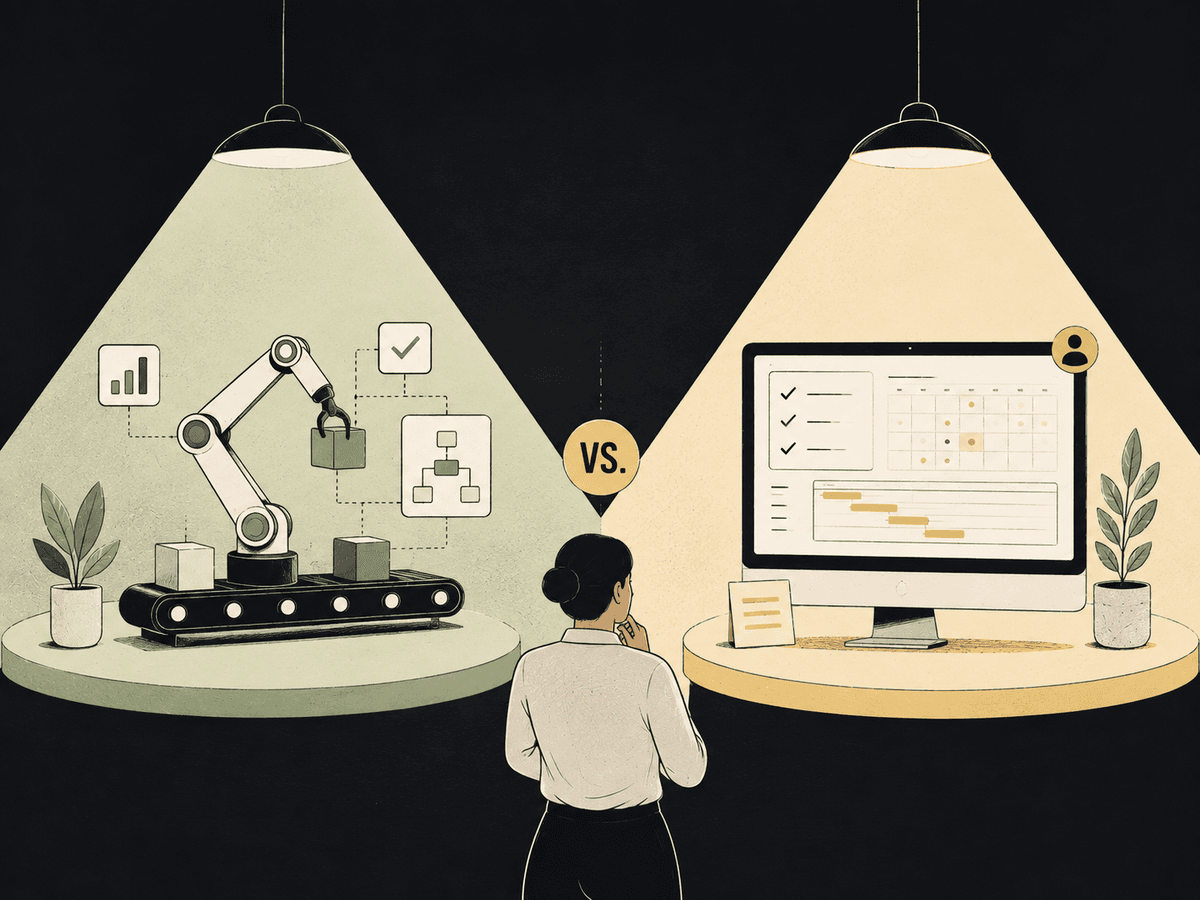
Close management software and close automation software solve different problems. Close management software tracks and evidences the close. Close automation software performs the work of the close. That distinction is the whole post, and most buyers do not have language for it.
Here is what goes wrong. A controller inherits a 10-day close. She buys close management software, builds a checklist, assigns owners, sets sign-off deadlines. Six months later the close is still 10 days — but now everyone can see exactly which 10 days, and the auditor gets a clean evidence package. That is a real gain. It is not the gain she was promised internally.
Close management software makes a slow close visible and defensible. It does not make it shorter. Only removing human execution steps makes it shorter.
Key takeaways
• Close management software governs the close: task lists, owners, due dates, reconciliation certification, sign-off trails, evidence storage. BlackLine, FloQast, Trintech and Workiva are the well-known names in this category.
• Close automation software executes the close: pulling bank files, matching cash to invoices, posting recurring journal entries, reconciling subledgers to the general ledger, routing only the breaks to a human.
• The two categories overlap at exactly one point — reconciliation. Management software certifies that a reconciliation was done and reviewed. Automation software does the reconciling.
• APQC, across more than 10,000 organizations, puts the median monthly consolidated close at 6 days, top performers at 5 days or less, and bottom performers at 10 or more calendar days. Visibility tooling alone rarely moves a team between those tiers.
• Most mid-market teams should run both, with automation underneath and management on top. Some teams — under roughly 60 close tasks with a disciplined controller — can skip the management layer and spend the budget on execution.
• Loopfour, the deterministic finance workflow automation platform, sits in the automation category: programmatic execution with a full audit trail on every action, not a checklist that reminds a human to act.
Close automation vs close management software: the comparison
| Category | What it does | Representative tools | What it does NOT do | | --- | --- | --- | --- | | Close management software | Tracks close tasks, owners and due dates. Certifies reconciliations. Stores supporting evidence. Enforces preparer and reviewer sign-off. Produces close status dashboards and audit packages. | BlackLine, FloQast, Trintech, Workiva | Does not pull source data, match transactions, calculate balances, or post journal entries. Does not reduce the number of human execution steps. | | Close automation software | Performs close work end to end: retrieves data from banks and systems of record, matches cash to open invoices, prepares and posts journal entries, reconciles subledger to general ledger, escalates exceptions. | Loopfour Studio, native ERP automation modules, purpose-built reconciliation engines | Does not replace formal close governance, entity-level certification programs, or SOX documentation frameworks on its own. | | The overlap | Reconciliation. Both categories claim it. They mean different things by it. | Both | Neither category alone gives you both a shorter close and a governed close. |
What close management software actually does
Close management software is a system of record for the close process itself. Close management software tracks who owns each task, when it is due, whether it was completed, who reviewed it, and what evidence supports it. The output is control and visibility, not throughput.
A typical implementation covers:
• Close checklist and calendar — every task, owner, dependency and due date for the period.
• Reconciliation certification — the preparer attests a balance sheet account is reconciled; the reviewer approves; the platform records both with timestamps.
• Evidence repository — bank statements, schedules, screenshots and support attached to the account they substantiate.
• Risk rating and thresholds — high-risk accounts get tighter review; low-risk, low-balance accounts can auto-certify under policy.
• Status reporting — the controller sees day 3 of a 6-day close at a glance, and which two accounts are blocking consolidation.
This is genuinely valuable. Protiviti's 2025 SOX survey found nearly 70% of organizations have implemented automated compliance tools, and 68% are prioritising additional technology and automation. Close management platforms are a large part of that first number. They turn a close that lived in a spreadsheet and a controller's head into a documented, repeatable, testable process.
What close management software does not do: the work. The reconciliation still gets prepared by a person in Excel. The intercompany elimination still gets calculated by a person. The accrual still gets posted by a person. The platform records that the person did it.
What close automation actually does
Close automation software performs close tasks programmatically, without a human executing each step. Close automation software connects to the systems where the data lives, applies predefined rules, writes results back, and surfaces only the cases the rules could not resolve.
Concretely, in a month-end context:
• Bank reconciliation — retrieve the statement, match against general ledger cash activity on predefined rules, flag unmatched items.
• Cash application — read remittance detail, match payments to open invoices in QuickBooks, NetSuite, Xero, Sage Intacct or Rillet, apply the cash, escalate short pays.
• Recurring journal entries — calculate prepaid amortisation, accruals and allocations from source data, post them, attach support.
• Subledger-to-general-ledger tie-out — pull both balances, compare, post the difference detail to the exception queue.
• Revenue recognition support — read the contract, extract the performance obligations, produce the schedule under the ASC 606 five-step model, route it for review.
The economics here are the ones with published evidence behind them. Levvel Research puts the manual cost per invoice at $10 to $15, versus $2 to $3 automated. IOFM measures manual invoice error rates around 2%, falling below 0.8% when automated. Those are AP figures, but the mechanism generalises: removing human keystrokes removes both cost and error.
At Loopfour, execution is deterministic. A workflow built on the canvas in Loopfour Studio runs identically on run #1 and run #1,000,000. Every block records its inputs, outputs and decisions in an execution tree. AI gets called for scoped tasks only — reading a contract, extracting fields from an invoice PDF — with a confidence threshold and a named human who reviews anything below it.
Where the two categories overlap: certification vs reconciliation
The overlap zone is reconciliation, and it is where most buying confusion lives. Close management software certifies reconciliations. Close automation software performs reconciliations. Both use the same word.
Here is the practical difference on a single account — operating cash, 4,000 transactions a month:
| Step | Under close management software | Under close automation | | --- | --- | --- | | Pull bank statement | Analyst downloads it | Workflow retrieves it on a schedule | | Match transactions | Analyst builds an Excel match, two to four hours | Workflow matches on predefined rules, minutes | | Investigate breaks | Analyst reviews all unmatched lines | Only unmatched lines reach a human, as exceptions | | Document the result | Analyst uploads support, clicks certify | Execution tree is the support; reviewer approves the exception queue | | Reviewer sign-off | Reviewer approves in the platform | Reviewer approves in the platform, or in Slack |
Close management software improves steps four and five. Close automation software removes steps one and two and shrinks step three. The time is in steps one through three.
Ardent Partners finds over 60% of invoices still require some human interaction. That is the residue automation leaves behind — and it is exactly what a human-in-the-loop approval step and a management-layer certification are for. Neither category eliminates the other.
The stack that makes sense together
For most mid-market finance teams, the stack that works puts automation underneath and management on top. Close automation software does the work and produces the evidence; close management software governs, certifies and reports on it.
The working division of labour:
• Automation layer → executes reconciliations, cash application, recurring entries, subledger tie-outs, flux variance data pulls. Emits a complete audit trail per run.
• Management layer → holds the close calendar, task ownership, risk ratings, certification workflow, reviewer sign-off, auditor-facing evidence package.
• Integration point → the automation layer marks tasks complete and attaches its execution record; the management layer certifies against it.
The failure mode to avoid is buying the management layer and treating it as the automation layer. The checklist gets greener over time because people get faster at the checklist, not because the work shrank. Track your close duration before and after any management-software implementation. If day count did not move, the tool is doing its job — governance — and your bottleneck is elsewhere.
The case for skipping one
Some teams genuinely need only one layer. Two honest cases:
Skip the management layer when your close has under roughly 60 discrete tasks, one controller reviews everything, entity count is low, and you are not yet in a SOX regime. A well-structured checklist plus an automation platform that logs every action gives you most of what a management platform provides, at a fraction of the implementation cost. Revisit when entity count grows, when you take on external audit for the first time, or when close ownership spreads across more than four people.
Skip the automation layer when — and this is rarer than vendors suggest — your close is already at or under the APQC top-performer mark of 5 days or less, your ERP handles the mechanical work natively, and your remaining close time is judgment: valuation, technical accounting, disclosure drafting. Automation does not compress judgment. It compresses execution.
The diagnostic is simple. If you removed every human from your close for one cycle, how much of it would still complete? If the answer is "most of it," your constraint is coordination and you need management software. If the answer is "almost none of it," your constraint is execution and you need automation.
What the auditor receives under each model
Auditors receive different artifacts under each model, and both are defensible. Close management software gives the auditor a certification trail. Close automation software gives the auditor an execution record. The strongest position holds both.
Under close management software, the auditor receives:
• The close calendar with completion timestamps
• Reconciliation certifications naming preparer and reviewer
• Attached support for each certified account
• Evidence of segregation of duties in the sign-off chain
• A population of accounts with risk ratings and certification status
Under deterministic close automation, the auditor receives:
• The workflow definition — the predefined rules applied, versioned
• A run-level execution tree: every input, every decision, every output, timestamped
• The exception population, with the human who reviewed each one
• Confidence scores and threshold settings for any AI-assisted extraction step
• Proof that the same rules ran identically every period
That last line matters more than it reads. Consistency of application is a control objective in its own right. A deterministic workflow that executed the same logic 12 times in 12 months is easier to test than 12 spreadsheets prepared by three different analysts.
This is also where probabilistic tooling struggles. The FinanceReasoning benchmark (ACL 2025, arXiv:2506.05828) tested 2,238 financial problems. The strongest reasoning model, OpenAI o1 with Program-of-Thought prompting, reached 89.1% on the hard subset — and numerical calculation errors accounted for roughly 37.5% of failures. An 89% success rate is impressive research. It is not a close process. Loopfour runs the arithmetic in code, deterministically, and reserves the model for language tasks like reading a contract clause — always with a confidence threshold and a human reviewer beneath it.
How to choose
Diagnose the cause of your close duration first. The cause determines the category. Buying the wrong one produces a well-documented slow close or an undocumented fast one.
Run this diagnostic:
| Symptom | Root cause | Category to buy | | --- | --- | --- | | Nobody knows what is left to do on day 4 | Untracked tasks | Close management | | Tasks get missed and rediscovered during review | No ownership or dependency model | Close management | | Auditor asks for support and it takes two days to assemble | Evidence scattered | Close management | | Two analysts spend three days matching transactions | Human execution | Close automation | | Cash application backlog delays AR close every month | Human execution | Close automation | | Recurring entries are calculated by hand in Excel | Human execution | Close automation | | Close is documented, governed, and still takes 9 days | Human execution under good governance | Close automation |
Then order the sequence:
• Measure your current close in calendar days, trial balance to consolidated financial statements. Compare to the APQC median of 6 days.
• Time-log one close cycle by task. Separate coordination time from execution time.
• If execution time exceeds 60% of the total, automation is your lever.
• If coordination and review time dominate, management software is your lever.
• If you are entering SOX scope or first-time audit, buy the management layer regardless of close duration.
Frequently asked questions
Do I need both BlackLine and a close automation platform?
Often, yes — they cover different halves of the problem. BlackLine and comparable platforms govern the close: task tracking, reconciliation certification, sign-off and evidence. A close automation platform performs the underlying work so fewer humans have to. Teams with straightforward close governance and heavy manual execution sometimes start with automation alone and add the management layer when entity count or audit scope grows.
Is this just an AI agent with a wrapper?
No. Loopfour executes workflows programmatically and deterministically — the same inputs produce the same outputs on run #1 and run #1,000,000, with a complete audit trail on every action. AI gets called for specific, scoped tasks such as reading a contract or extracting fields from an invoice, each with a confidence threshold and a defined human reviewer for anything below it. An agent that reasons its way through your close fresh each month is not auditable, and we do not build that.
Will close management software shorten my close?
Usually by a small amount, and indirectly. Close management software eliminates rework, forgotten tasks and hunting for support, which recovers some hours. It does not reduce the hours a person spends preparing a reconciliation or calculating an accrual. If your close sits at the APQC bottom-performer mark of 10 or more calendar days, expect governance improvement first and duration improvement only where coordination waste was the cause.
What is a realistic close-day reduction from automation?
Model it from your own time log rather than a vendor benchmark. As an illustrative scenario: a team spending 40 hours per close on bank reconciliation, cash application and recurring entries, automating roughly 70% of that volume, recovers about 28 hours and removes two sequential days from the critical path. That is a modeled projection based on task-level time inputs, not a measured customer result — build the same model with your own numbers before you buy anything.
Can close automation post journal entries directly into my ERP?
Yes, where the ERP supports it. Loopfour connects to QuickBooks, NetSuite, Xero, Sage Intacct and Rillet, and posts entries through their APIs with the full execution record attached. Where a system has no usable API, Loopfour uses browser automation as a fallback and logs each step the same way. Posting can be gated behind an approval block so a controller reviews before anything hits the ledger.
How does deterministic automation hold up in a SOX environment?
Well, because the control is testable. An auditor can read the workflow definition, see the predefined rules, and inspect the execution tree for any run in the period. Loopfour is SOC 2 Type II certified with a SOC 1 audit underway, encrypts data at AES-256 at rest and TLS 1.3 in transit, and never uses customer data to train models. Protiviti's 2025 SOX survey found 68% of organizations prioritising additional technology and automation — testability is the reason.
We are a fractional CFO firm running eight clients. Which layer first?
Automation, in most cases. Fractional and advisory firms carry execution load across many small closes, and each client's close is mechanically similar. A deterministic workflow built once and deployed per client removes repeated execution work; a management platform licensed per client rarely pays back at that scale. Add governance tooling for the clients that enter audit or SOX scope.
The distinction, one more time
Close management software tracks and evidences the close. Close automation software performs the close. A team that buys management software expecting a shorter close has bought a good product for the wrong reason. A team that buys automation with no governance layer has a fast close that is harder to explain.
Most finance teams need both, in that order: automate the execution, then govern what remains. The APQC median of 6 days is not a coordination problem for most organizations. It is an execution problem.
Loopfour builds, runs and monitors deterministic finance workflows on the stack you already have — QuickBooks, NetSuite, Xero, Sage Intacct, Rillet, Stripe, Salesforce, HubSpot, Slack and the rest — and routes only the exceptions to your team for approval.
Book a workflow review. We will map one close cycle task by task, separate coordination time from execution time, and tell you which category you actually need — including when the answer is neither.