
Audit trails for automated finance: how to keep every run inspectable
Compliance angle. Shows how deterministic workflows log every step so automated finance holds up under audit.
By Loopfour
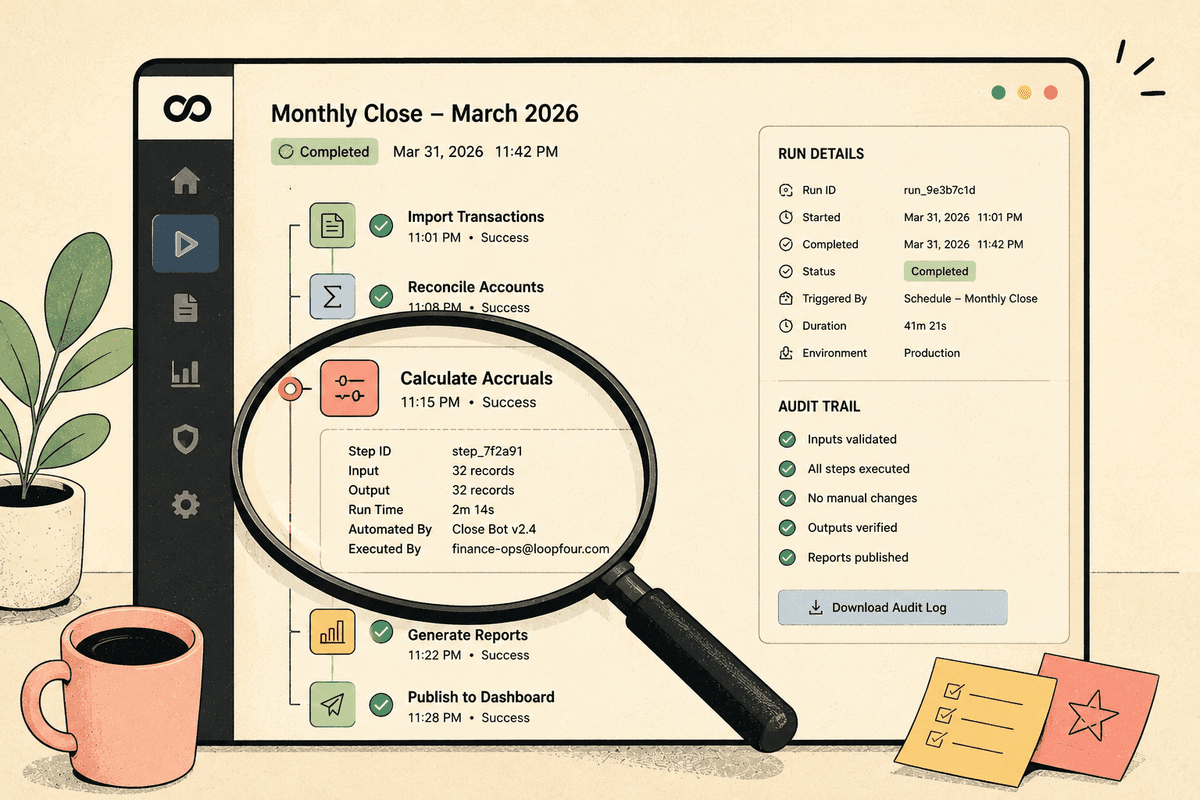
Your board wants AI in finance. Your auditors want it to hold up. Those two demands feel like they pull in opposite directions, but they do not have to. An audit trail for automated finance is a complete, ordered record of every action a workflow takes: each step, its inputs, its outputs, any confidence score, and every human approval, all captured so a reviewer can reconstruct exactly what happened and why. When automation produces that record by default, the board and the auditor get what they need from the same run. The rest of this guide explains what that trail should contain, why most automation fails to produce it, and how to evaluate a system before you sign off.
Key takeaways
- An audit trail for automated finance records every step, input, output, confidence score, and approval so any run can be reconstructed and explained after the fact.
- Probabilistic AI agents fail the audit because they cannot reproduce a run or show the reasoning behind a specific output.
- Deterministic execution is the fix. Loopfour runs each workflow as real code that behaves identically every run and logs every action to an execution tree.
- Human-in-the-loop approvals belong in the record. Your controllers approve only the exceptions, and each approval is timestamped and attributed.
- AI is scoped, not central. It is called for specific steps under a confidence threshold, with a human fallback when the threshold is not met.
- Certifications and access controls are part of audit-readiness, not a separate concern: SOC 2 Type II, AES-256 at rest, TLS 1.3 in transit, and data that is never used to train models.
What an audit trail for automated finance actually is
An audit trail for automated finance is a durable, ordered log of every action a workflow performs, detailed enough that a reviewer can reproduce the run and explain each decision without asking the person who built it. It is not a summary of what the system intended to do. It is the actual record of what it did.
For a finance operation, that means the trail has to answer specific questions. Which invoice triggered this run? What data was read from NetSuite, and at what time? Which step matched the purchase order, and what did it return? Where did a human step in, and what did they approve? A trail that cannot answer those questions is a report, not an audit trail. The test is reproducibility: can a reviewer follow the record and arrive at the same result the system produced? If the answer is no, the automation is not audit-ready, regardless of how it is marketed.
Loopfour, the deterministic finance workflow automation platform, builds this record as a byproduct of how workflows run rather than as a feature bolted on afterward. Every action writes to the execution tree, so the trail is complete by construction.
Why most automation fails the audit
Most automation fails the audit because it cannot reproduce or explain a specific run. This is the core problem with probabilistic AI agents applied to finance work, and it is worth being precise about why.
A probabilistic system produces outputs by sampling. Give it the same reconciliation twice and it may take two different paths, categorize a transaction two different ways, or explain itself with two different rationales. An AI agent cannot show its work. It produces an answer, not a record of how the answer was derived. When your auditor asks why a particular journal entry was posted in March, "the model decided" is not an acceptable answer under SOX-style controls, and it will not satisfy an ASC 606 revenue review.
The failure has three specific dimensions:
- Non-reproducibility. The same input can yield a different output on a later run, so a reviewer cannot re-execute the process to confirm the result.
- No causal record. The system stores the output but not the ordered chain of inputs and intermediate steps that produced it.
- Opaque exceptions. When something goes wrong, there is no way to isolate which step failed or why, so remediation becomes guesswork.
None of this is a knock on AI as a technology. It is a statement about where probabilistic behavior belongs. It does not belong in the control path of a financial process that has to be defended to an auditor.
What a complete, inspectable run looks like
A complete, inspectable run is one where every action is captured in an execution tree: a structured log that records each step, its inputs, its outputs, any confidence score, and every human approval, in order. Open the tree for any run and you can trace the workflow from trigger to result without ambiguity.
Consider a vendor invoice moving through a close workflow. The execution tree records a sequence like this:
Invoice received in the queue → data extracted and written to the run (vendor, amount, date, line items) → purchase order matched in NetSuite → amounts and terms compared → confidence score recorded for the match → exception flagged because the amount exceeds the PO by 4 percent → routed to a controller for approval → controller approves with a note → journal entry posted → run closed and sealed in the execution tree
Every node in that sequence carries its own detail. The match step shows what it compared and what it returned. The exception step shows the threshold that was crossed. The approval step shows who approved, when, and what they saw. Because the run is deterministic, re-executing the same inputs produces the same tree, which is exactly what a reviewer needs to verify the process.
This is the difference between an audit trail that describes a system and one that reconstructs it. An AI agent cannot show its work. Loopfour logs every step instead, and the log is the run, not a description of it.
Deterministic execution vs black-box automation
Deterministic execution means a workflow runs as real code that behaves identically every time, while black-box automation produces outputs you cannot reproduce or trace. The distinction determines whether your automation survives review.
| Dimension | Black-box automation | Loopfour deterministic execution |
|---|---|---|
| Reproducibility | Same input can yield different output | Same input yields the same output every run |
| Record of reasoning | Output only, no causal chain | Full execution tree: step, input, output, approval |
| Role of AI | Central and unbounded | Scoped to specific steps under a confidence threshold |
| Exceptions | Opaque; hard to isolate a failed step | Flagged, routed to a human, logged with context |
| Human control | Often none, or after the fact | Approvals in the control path, before the action commits |
| Auditor experience | "The model decided" | Re-executable run with a timestamped, attributed trail |
The point of the contrast is not that AI has no place. It is that AI should be called surgically, for a bounded task like classifying a line item, with a confidence threshold and a human fallback when the threshold is not met. The workflow around it stays deterministic. That is what keeps the run inspectable while still using AI where it genuinely helps.
How to evaluate automation for audit-readiness
Evaluate automation for audit-readiness by testing it against five specific requirements, not against marketing claims. Each one is something your auditor or controller can check directly, and each one is where black-box tools tend to fall short.
- Reproducibility. Ask the vendor to run the same input twice and show that the outputs and the internal steps are identical. If they cannot, the system is probabilistic in its control path and will not reproduce under review. Loopfour runs every workflow as real code, so the same run produces the same result and the same execution tree.
- Logging depth. Confirm that the trail captures each step, its inputs, its outputs, and any confidence scores, not just a final status. A pass or fail flag is not an audit trail. The execution tree logs every action at the step level.
- Approvals in the control path. Verify that human approvals happen before an action commits, not as an after-the-fact review, and that each approval is timestamped and attributed. Your controllers should approve only the exceptions, and each approval should live in the record.
- Access controls. Check who can trigger, modify, and approve runs, and confirm that those permissions are enforced and logged. Ask how data is protected in transit and at rest. Loopfour uses AES-256 at rest and TLS 1.3 in transit, and data is never used to train models.
- Certifications. Ask for current attestations. Loopfour is SOC 2 Type II certified, with a SOC 1 audit underway and HIPAA controls in place. These are the documents your auditor will ask for, so it is faster to confirm them at evaluation than after a deal.
Run any tool through these five and the audit-ready ones separate quickly from the ones that only describe their work.
Frequently asked questions
Can AI run my close without breaking the audit trail?
Yes, provided the AI is scoped and the workflow around it is deterministic. In Loopfour, AI is called for specific steps, such as classifying a transaction, under a confidence threshold, with a human fallback when the threshold is not met. The workflow that orchestrates the close runs as real code and logs every action, so the trail stays complete even where a step uses AI.
Is this just an AI agent with a wrapper?
No. Loopfour is not an AI agent with a wrapper. Execution is programmatic and deterministic: every workflow runs as real code that behaves identically every run and writes a full audit trail to an execution tree. AI is used surgically for bounded tasks, never as the central engine making unbounded decisions.
What exactly does the execution tree record?
The execution tree records every step in a run, along with its inputs, outputs, any confidence score, and every human approval, in order. Because the run is deterministic, re-executing the same inputs reproduces the same tree, which is what lets a reviewer verify the process rather than take it on faith.
How does Loopfour handle exceptions?
When a step falls outside expected parameters, such as an invoice that does not match its purchase order, Loopfour flags it as an exception and routes it to a human for approval. Your team approves only the exceptions, and each decision is logged with context in the execution tree. The rest of the run proceeds without manual intervention.
Which finance systems does this work with?
Loopfour builds and runs workflows on your existing stack, including QuickBooks, NetSuite, Xero, Sage Intacct, Stripe, Salesforce, HubSpot, Slack, DocuSign, and Workday. You do not replace your systems of record; Loopfour connects to them and orchestrates the work across them.
Conclusion
An audit trail is not a feature you add after automating a finance process. It is the evidence that the process can be trusted, and it has to be produced by the way the work runs. Deterministic execution, scoped AI with human fallback, approvals in the control path, and a complete execution tree are what turn automation from a risk into something your auditor can sign off on.
Tell us the one workflow your team dreads. We will show it running, deterministic, permissioned, and auditable.
Book a demo.
Related reading
How to automate month-end close in 2026
Deterministic AI vs black-box AI in finance
AI in finance: the compliance risks finance leaders can't ignore