
AI in finance: the compliance risks finance leaders can't ignore
Compliance angle. Names where AI breaks finance compliance and how logged, deterministic workflows keep outputs audit-ready.

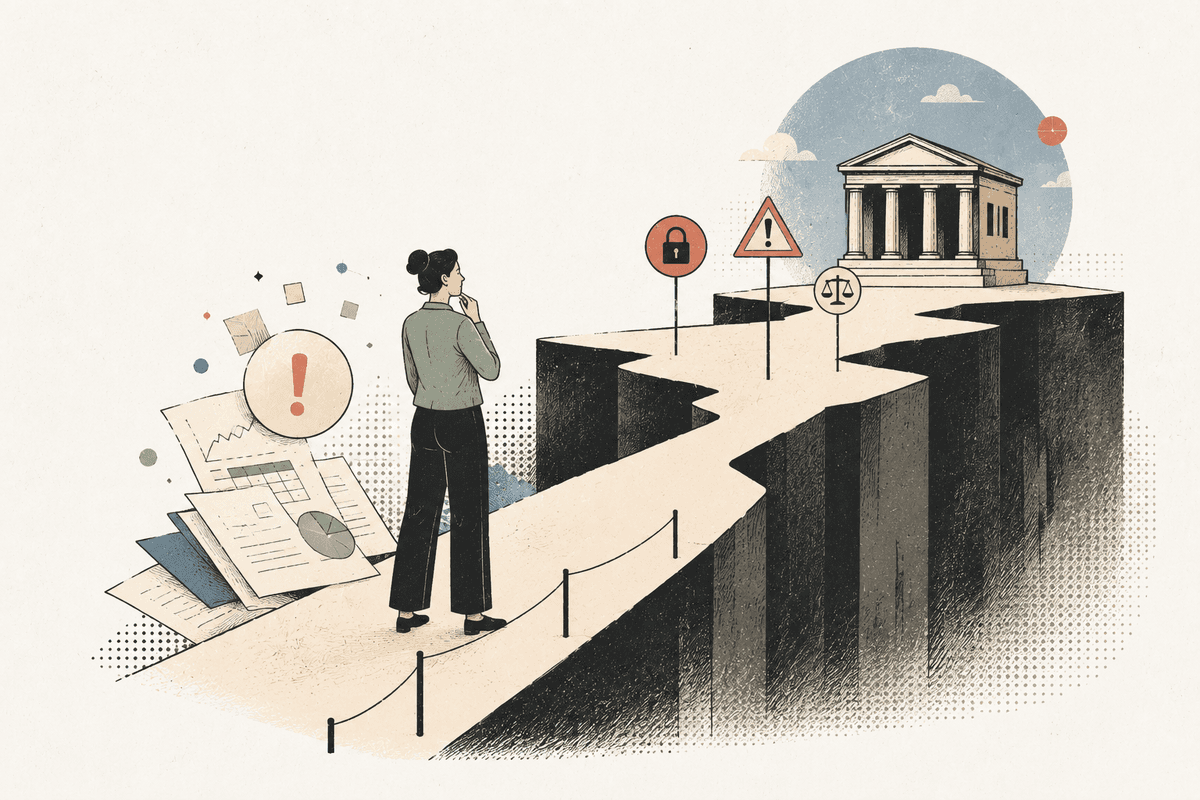
Finance leaders face a genuine tension. There is real pressure to adopt AI, and there is real exposure if you adopt it carelessly. The top compliance risks are the ones that break your controls: outputs you cannot reproduce, silent errors that reach the ledger, unclear accountability, data privacy exposure, weak access controls, and drift from standards like SOX-style internal controls and ASC 606. You control every one of them the same way: with deterministic execution, a complete audit trail, and a human approving the exceptions. That combination is what lets you automate without loosening the controls your auditors expect.
Key takeaways
- The core risk is reproducibility. If an automated step can produce a different result tomorrow on the same inputs, you cannot defend it in an audit.
- Name each risk specifically. Non-reproducible outputs, silent errors, unclear accountability, data exposure, weak access control, and standards drift are distinct problems with distinct controls.
- Determinism beats probability for finance work. A probabilistic agent decides what to do at runtime. Deterministic automation does only what was approved, every run.
- AI belongs in scoped steps, not the whole workflow. Call it for a narrow task, gate it with a confidence threshold, and route low-confidence cases to a person.
- An audit trail is not optional. You need to show what ran, on what data, in what order, and who approved it.
- Certifications and data handling are proof, not marketing. SOC 2 Type II, encryption standards, and a no-training data policy are the evidence your risk review will ask for.
Why AI compliance risk is different in finance
In finance, an output is only as good as your ability to reproduce and evidence it. Marketing can tolerate a model that writes a slightly different caption each time. A close process cannot tolerate a step that posts a slightly different entry each time. The bar is higher because the work feeds financial statements, and those statements are reviewed against controls.
Three properties raise that bar. Auditability means you must be able to show exactly what happened. Reproducibility means the same inputs must produce the same result on demand. Controls means specific people approve specific actions, and that separation is documented. A probabilistic system strains all three at once. It can produce a defensible answer and an indefensible one from the same prompt, and it rarely leaves a record you can hand to an auditor without translation.
This is why "add AI to finance" is the wrong frame. The right frame is: automate the workflow deterministically, and call AI only where a scoped, gated task genuinely helps.
The compliance risks finance leaders can't ignore
Below are the risks worth naming precisely. Each is a real exposure, and each has a specific control.
Non-reproducible outputs and missing audit trails
If you cannot rerun a process and get the same result, you cannot evidence it. A probabilistic agent can classify a transaction one way today and another way next week, with no record of why. When an auditor asks how a figure was derived, "the model decided" is not an answer that closes the finding.
Example: a vendor invoice is coded to one GL account this month and a different one next month, because the model weighed the description differently. Both runs look complete. Neither is reproducible, and the inconsistency surfaces only during review: the worst possible time.
Silent errors and hallucinated figures
The dangerous errors are the ones that look right. A model that fills in a plausible but wrong number does not throw an exception. It produces a clean-looking result that flows downstream until someone notices the totals do not tie.
Example: an AI step summarizing a contract infers a renewal amount that was never stated, and that inferred figure lands in a revenue schedule. Nothing failed loudly. The error is silent, and it is now inside your reporting.
Unclear accountability and control ownership
Every control needs an owner, and "the AI" cannot be one. When an automated action goes wrong, your controls framework needs to answer who approved it and who is accountable. A system that acts on its own judgment blurs that line precisely where auditors look hardest.
Example: an automated payment run releases a duplicate payment. If no named person approved the exception, you have a control gap, not just an error, and control gaps are what get written up.
Data privacy and model training exposure
Financial data handed to the wrong system can leave your control boundary. If a tool sends your ledger data to a model that trains on inputs, you have created an exposure you cannot fully reverse. Customer data, contract terms, and payment details are exactly the information that must stay contained.
Example: a workflow pastes customer payment records into a general-purpose model whose terms permit training on submissions. The data is now outside your governance, and you may not be able to prove where it went.
Access control and segregation of duties
Automation must respect the same permissions your people do. Segregation of duties exists so the person who creates a transaction is not the person who approves it. An automation that runs with broad, unscoped access quietly collapses that separation.
Example: a single automated process both creates a journal entry and posts it, with no independent approval. Functionally, one actor now does both jobs: the exact condition segregation of duties is designed to prevent.
Regulatory and standards alignment
Your automation has to fit the standards your statements are held to. SOX-style internal controls require documented, testable control activities. ASC 606 requires revenue to be recognized on defensible logic, not a model's shifting interpretation. GAAP expects consistency. Automation that cannot evidence its logic puts alignment with all of them at risk.
Example: an AI step decides when a performance obligation is satisfied for revenue recognition. If that decision is not reproducible and documented, your ASC 606 treatment rests on logic you cannot show: a problem in any controls review.
How to reduce AI compliance risk without abandoning automation
You do not have to choose between automation and control. You have to choose the right architecture. The goal is a system that executes the same way every time, records everything it does, and puts a person at every decision that matters.
Start with deterministic execution. A probabilistic agent can post a different entry tomorrow. Deterministic automation posts the approved entry every time instead. When logic is programmatic and fixed, reproducibility stops being a hope and becomes a property of the system.
Add a real audit trail. Every run should produce a complete record: what ran, on what inputs, in what order, and what a person approved. At Loopfour we call this the execution tree: a step-by-step account of the run that you can hand to an auditor without reconstruction.
Use AI surgically, not structurally. Where a model genuinely helps, reading an unstructured document, suggesting a match, call it for that scoped step only, behind a confidence threshold. Above the threshold, the step proceeds. Below it, the work routes to a person. That is human-in-the-loop by design: you approve only the exceptions, not every routine action.
Finally, demand proof of data handling. Loopfour, the deterministic finance workflow automation platform, is SOC 2 Type II certified, with a SOC 1 audit underway and HIPAA controls in place. Data is encrypted with AES-256 at rest and TLS 1.3 in transit, and your data is never used to train models. Loopfour Studio, our visual, canvas-based workflow builder, connects your existing stack, NetSuite, QuickBooks, Stripe, Slack, so automation runs inside your controls rather than around them. An AI agent decides what to do at runtime. Loopfour does only what was approved.
A checklist for evaluating AI finance tools for compliance
Use this as a screening list before any finance tool touches your ledger. If a vendor cannot answer these plainly, treat that as the answer.
- Reproducibility → Does the same input produce the same output on every run, or can results drift?
- Audit trail → Does each run produce a complete, exportable record of what happened and who approved it?
- Scope of AI → Is AI confined to narrow, defined steps, or does it make open-ended runtime decisions?
- Confidence gating → Are low-confidence results routed to a person, or acted on automatically?
- Human control points → Can you require approval on exceptions and high-impact actions?
- Access and segregation → Does the tool honor role-based permissions and keep creation separate from approval?
- Data handling → Is data encrypted in transit and at rest, and is it ever used to train models?
- Certifications → Is there SOC 2 Type II or equivalent evidence you can share with your risk team?
- Standards fit → Can the logic support SOX-style controls, ASC 606, and GAAP consistency under review?
Frequently asked questions
Is it safe to use AI for financial reporting?
It is safe when AI is confined to scoped steps and every result passes through a human control point. The risk comes from letting a model make open-ended decisions that reach your statements unchecked. Keep the execution deterministic, gate AI with confidence thresholds, and require approval on exceptions, and you keep both the efficiency and the control.
Can AI break my SOX controls?
Yes, if it acts without documentation, reproducibility, or clear ownership. SOX-style controls depend on testable, evidenced activities, and a system that decides at runtime undermines all three. Deterministic automation with a complete audit trail supports those controls rather than eroding them, because every action is recorded and approved.
What is the difference between deterministic and probabilistic automation?
Deterministic automation runs fixed, programmatic logic and produces the same result on the same inputs every time. Probabilistic automation, including most AI agents, can produce different results from identical inputs. For finance work that has to be reproduced and evidenced, determinism is the safer foundation.
How do we keep our financial data private when using AI?
Confirm that data is encrypted in transit and at rest and that it is never used to train models. Ask the vendor for their certifications and data handling terms in writing. Keep sensitive data inside a system with defined governance rather than pasting it into general-purpose tools.
Do we still need people in the loop if the system is automated?
Yes, and that is the point. Good automation removes the routine work and routes the judgment calls to a person. You approve only the exceptions, which means your team spends its attention where accountability actually matters.
Conclusion
AI in finance is not a choice between moving fast and staying compliant. The exposure comes from architecture, not ambition: from systems that decide at runtime, leave no trail, and act without approval. Choose determinism, insist on a full audit trail, and keep a person on every exception, and you get automation your auditors can stand behind.
Tell us the one workflow your team dreads. We will show it running: deterministic, permissioned, and auditable.
Book a demo.
Related reading
Deterministic AI vs black-box AI in finance
Audit trails for automated finance
How to automate month-end close in 2026