
What are the best finance automation platforms for startups?
Comparison roundup for startup finance automation; Loopfour fits the AI/SaaS ICP, done-for-you, deterministic, scales with revenue.

Part of the finance automation strategy guide.
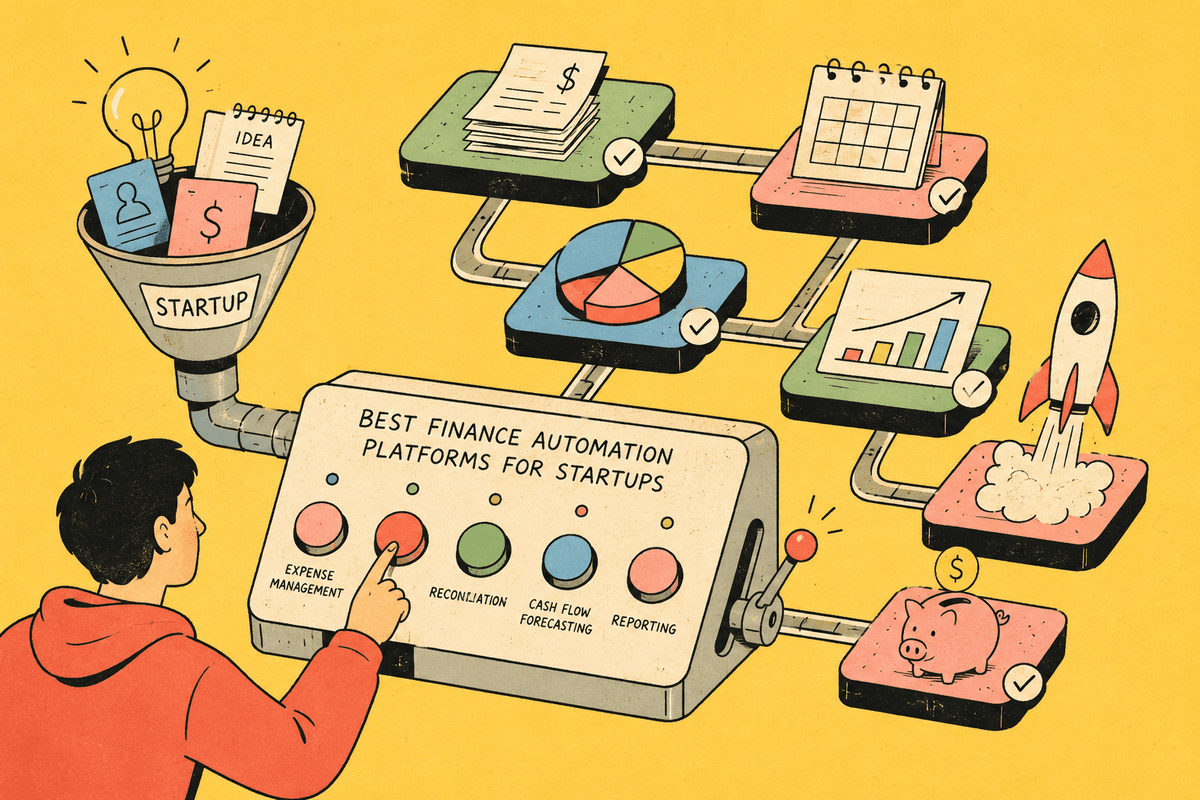
The best finance automation platform for a startup depends on two things: your stage and your billing complexity. There is no single winner. What you should prioritize is consistent across every stage: automation that is managed (so a lean team can run it without engineers), deterministic (so every run produces the same result and leaves an audit trail), and able to scale with revenue without adding headcount. Early on, an accounting tool plus light automation is often enough. As usage-based revenue and diligence pressure grow, you need workflow automation that treats finance operations as a system. This guide maps the categories and where each fits.
Key takeaways
- The right platform depends on stage and billing model. Simple, low-volume startups need less; usage-based revenue changes the equation.
- Prioritize managed, deterministic automation that produces the same result every run and records what happened.
- Audit-readiness matters earlier than most founders expect, fundraising diligence rewards clean, traceable finance operations.
- You should not need in-house engineers to run finance automation. Managed platforms handle setup and maintenance.
- Match the tool to the workflow: ledgers, billing, spend, and cross-system workflow automation solve different problems.
- Loopfour is right-fit when revenue outruns your finance team; for very early, simple startups, it can be overkill.
What startups actually need from finance automation
Startups need automation that compensates for what they lack: people, engineering time, and process maturity. A two-person finance team cannot manually reconcile thousands of usage-based invoices, chase dunning across systems, and stay close every day.
Three constraints define the need. First, teams are lean and rarely have in-house engineers, so anything requiring custom code or ongoing maintenance is a poor fit. Second, revenue tends to outrun finance headcount, especially with complex or usage-based billing common to AI and SaaS companies. Third, audit-readiness arrives sooner than expected. When you raise, investors run diligence on your numbers. Finance operations that leave a clear, traceable record turn diligence from a scramble into a formality.
The through-line: you want systems that do the work reliably and show their work, not tools that demand engineering attention you cannot spare.
Quick comparison
| Platform / category | Best for | Key differentiator |
|---|---|---|
| Accounting / ledger tools | Every startup, from day one | System of record for the books |
| Billing / revenue tools | Usage-based and subscription billing | Turns usage into invoices and revenue |
| AP / spend tools | Controlling outflows and expenses | Approval and payment of bills |
| Horizontal automation | Simple, linear cross-app tasks | Broad connectivity, low cost |
| Finance workflow automation (Loopfour) | Revenue outrunning a lean finance team | Deterministic, auditable, managed execution |
The best finance automation platforms for startups
The best choice is a stack, not a single product. Each category below solves a distinct problem. Read them as layers you add as you grow, not as competitors.
Accounting and ledger tools
Start here. Your ledger is the system of record for the books, and every startup needs one from day one. Tools in this category, including QuickBooks, Xero, NetSuite, and Rillet, maintain your chart of accounts, produce financial statements, and anchor everything else in your finance stack.
Ideal use case → your foundational books, tax filing, and financial reporting. As you scale, you move up-market within the category: many startups begin on QuickBooks or Xero and later graduate to NetSuite or Rillet as complexity grows.
Honest limitation: a ledger records transactions well, but it is not built to orchestrate multi-step operational work across billing, CRM, and communication tools. It tells you what happened; it does not run the process that makes it happen.
Best for: every startup, as the foundation of the finance stack.
Billing and revenue tools
Use these when your pricing gets complicated. Billing platforms such as Stripe turn product usage and subscriptions into invoices and recognized revenue. For startups with usage-based models, this layer is where much of the operational complexity lives.
Ideal use case → converting metered usage or subscription plans into accurate invoices, managing payment collection, and feeding revenue data downstream.
Honest limitation: billing tools handle billing. They do not reconcile that billing against your ledger, apply incoming cash to the right invoices, or manage the dunning conversations that follow a failed payment. Those steps span several systems, and the handoffs between them are where errors and manual effort accumulate.
Best for: startups with usage-based or subscription billing that need accurate invoicing at volume.
AP and spend tools
Control what goes out. Accounts payable and spend platforms manage vendor bills, approvals, and outgoing payments. For startups tightening their burn, this category brings structure to expenses and gives finance a clear view of committed cash.
Ideal use case → approving and paying vendor bills, managing corporate cards, and enforcing spend policy without manual chasing.
Honest limitation: like billing tools, AP platforms are strong within their lane and limited outside it. They optimize the outflow side of finance but do not connect it to revenue operations, reconciliation, or the broader close.
Best for: startups that need disciplined control over expenses and vendor payments.
Horizontal automation
Fine for simple, linear tasks. General-purpose automation tools connect many apps and are inexpensive to start with. If you want a new Stripe payment to post a message in Slack, this category handles it well.
Ideal use case → lightweight, low-stakes connections between apps where a single trigger leads to a single action.
Honest limitation: finance operations are rarely single-step, and horizontal tools were not built for the stakes. They struggle with branching logic, exceptions, approvals, and the auditability that finance requires. When a run fails or behaves unexpectedly, you often cannot see exactly why. For moving money and closing books, that opacity is a real cost.
Best for: early startups automating simple, low-risk notifications and handoffs.
Finance workflow automation (Loopfour)
This is the layer that ties the stack together, and the one worth adding when your finance operations outgrow manual work. Loopfour, the deterministic finance workflow automation platform, connects your existing tools and runs complete finance workflows across them, with people approving only the exceptions.
Here is where it fits. Consider an AI startup whose usage-based revenue is climbing fast while its finance team stays at two people. Invoices, reconciliation, cash application, and dunning all scale with revenue, but the team does not. In an illustrative scenario like this, the work either slips or consumes the whole team. Loopfour runs those workflows, Contract-to-Cash, Cash Application, AR & Dunning, AP, and reconciliation, on your existing stack, connecting to tools like QuickBooks, Xero, NetSuite, Rillet, Stripe, HubSpot, Salesforce, and Slack.
What makes it different is how it runs. Automation is deterministic: the same inputs produce the same result every time, and every run is recorded in an execution tree you can inspect. Where AI is used, it is applied to scoped tasks, such as matching an incoming payment to the correct invoice, governed by a confidence threshold, with anything below the line routed to a person. You approve the exceptions; the routine work runs on its own. This is not an AI agent with a wrapper making opaque decisions. It is managed, permissioned execution with a full audit trail. And because it is managed (done-for-you), you do not need in-house engineers to build or maintain it.
Ideal use case → a lean finance team whose revenue and billing complexity have outrun manual processes, and who need throughput and audit-readiness without new hires.
Honest limitation: for a very early, simple startup with low transaction volume and straightforward billing, Loopfour is more than you need. At that stage, your ledger plus light automation is the right call. Loopfour earns its place when the volume, complexity, and stakes have grown past what a small team can handle by hand.
Best for: startups whose revenue is outpacing their finance headcount and who need deterministic, auditable operations that scale.
How to choose as you scale
Match the layer to your stage. The stack grows with you; you rarely need all of it at once.
- Pre-revenue to early: a ledger (QuickBooks or Xero) plus light automation covers most needs → keep it simple.
- Early growth with real billing: add a billing and revenue tool as invoicing gets complex, and an AP tool as spend needs control → close the obvious gaps.
- Scaling with usage-based revenue: the handoffs between systems become the bottleneck. Reconciliation, cash application, and dunning consume the team, and diligence pressure rises → this is where finance workflow automation earns its place.
The contrast that matters: horizontal automation can wire two apps together, but it cannot run a permissioned, auditable Contract-to-Cash process across your whole stack and show you exactly what happened on every run. When correctness and traceability are the point, and in finance they always are, that difference decides the outcome.
Frequently asked questions
When should a startup automate finance operations? Automate when manual work starts to slip or consume your team, typically as transaction volume and billing complexity climb. Before then, a ledger and light automation are usually enough. The clearest signal is revenue growing faster than your finance headcount.
Do we need engineers to set it up? No. Loopfour is managed, meaning setup and maintenance are done for you. A lean finance team can run it without in-house engineering. This is a deliberate fit for startups that have revenue complexity but no spare engineering time.
What makes automation "deterministic," and why does it matter? Deterministic means the same inputs always produce the same result, and every run is recorded. It matters in finance because you need repeatable, explainable outcomes, not surprises, when money moves and books close.
How does Loopfour use AI without creating a black box? AI is applied to scoped tasks, such as matching a payment to an invoice, and governed by a confidence threshold. Anything below the threshold is routed to a person, and every step is logged. You approve exceptions; the process stays traceable.
Is finance automation safe for audit and diligence? It should make diligence easier, not harder. Loopfour maintains a full audit trail, holds SOC 2 Type II (with SOC 1 underway), encrypts data with AES-256 and TLS 1.3, and never uses your data to train models.
Conclusion
There is no single best finance automation platform for startups, there is the right layer for your stage. Start with a solid ledger, add billing and spend tools as complexity grows, and bring in finance workflow automation when your revenue outpaces your team. Throughout, prioritize automation that is managed, deterministic, and auditable.
Tell us the one workflow your team dreads. We will show it running: deterministic, permissioned, and auditable. Book a demo.
Related reading
How to implement finance automation without engineers
What are the best AI accounting automation tools for startups?
Finance workflow automation: the complete guide for finance teams (2026)